

Witch house, p.1
Witch House, page 1


Jerry eBooks
No copyright 2024 by Jerry eBooks
No rights reserved. All parts of this book may be reproduced in any form and by any means for any purpose without any prior written consent of anyone.
$2.50
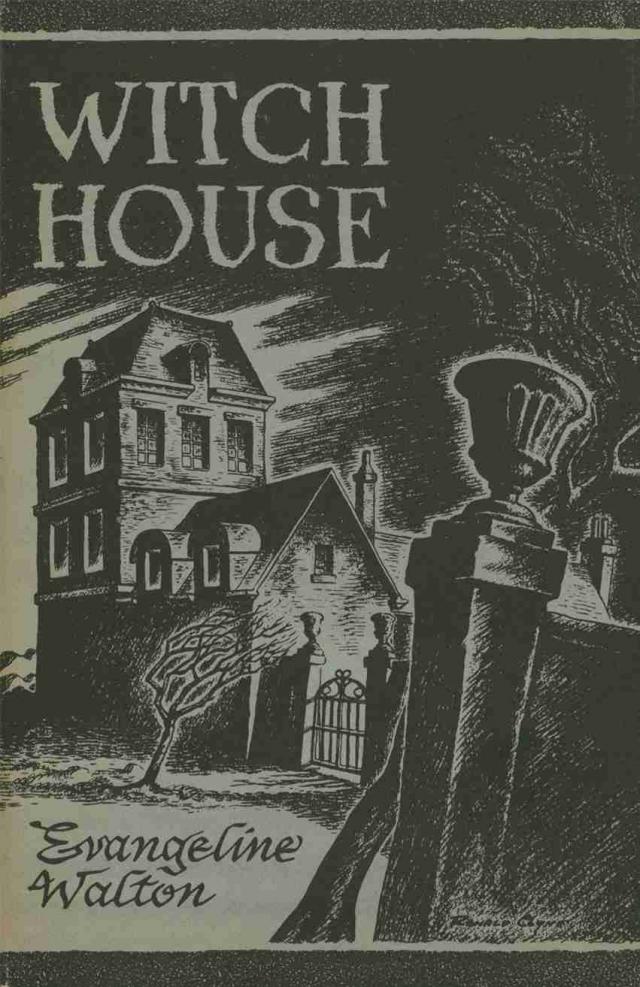
WITCH HOUSE
By EVANGELINE WALTON
When Elizabeth Stone sought the aid of Dr. Gaylord Carew to save her child, Betty-Ann, from strange and terrible danger, he soon discovered that a malign and horrible influence was at work in the lonely house off the New England coast. The others in the house—Joseph, Quincy, and Zoia—maintained that Betty-Ann suffered tantrums; Betty-Ann herself believed that the evil ghost of old Miss Sarai reached across the divide to torment her. The things that happened to Betty-Ann suggested sorcery to Dr. Carew, and when he sought to combat them, he found the vengeful influence behind them turned upon him as well.
Events move rapidly toward climax and anti-climax in this skillfully written novel which in its theme suggests Henry James’ The Turn of the Screw, and in its treatment Francis Brett Young’s Cold Harbour, though it is a completely original work of marked power and a fine quality of imaginative adventure. Miss Walton’s style is persuasive as well as powerful; Witch House is the product of a keenly imaginative and well disciplined mind.
«««
The jacket has been designed by Ronald Clyne.
THIS BOOK has been produced in wartime format, of lighter weight paper and smaller margins, to assure a more compact book, in accordance with government regulation. This book is complete and unabridged.
Witch House
BY
EVANGELINE WALTON
Copyright, 1945 by EVANGELINE WALTON
No part of this book may be reprinted without the permission of the publishers, Arkham House, Sauk City, Wisconsin. Printed in the United States of America.
Books by Evangeline Walton
THE VIRGIN AND THE SWINE
WITCH HOUSE
WITCH HOUSE is the first volume in the Library of Arkham House Novels of Fantasy and Terror. Other volumes in preparation include the following:
THE HORROR FROM THE HILLS
by Frank Belknap Long
THE TRAIL OF CTHULHU
by August Derleth
CONJURE WIFE
by Fritz Leiber, Jr.
THE LURKER AT THE THRESHOLD
by H. P. Lovecraft and August Derleth
INVADERS FROM THE DARK
by Greye La Spina
To my Quaker Grandmother
a staunch believer in this book
and to “Tuneless Thomas”
who was a kind of collaborator.
Witch House
For spirits, when they please,
Can either sex assume, or both; so soft
And uncompounded is their essence pure . . .
Nor founded on the brittle strength of bones,
Like cumbrous flesh; but in what shape they choose,
Dilated or condensed, bright or obscure,
Can execute their aery purposes,
And works of love or enmity fulfill.
—John Milton.
It is difficult to examine the subject with impartiality without coming to the conclusion that the historical evidence establishing the reality of witchcraft is so vast and so varied that nothing but our . . . modern experience of the manner in which it has faded away under the influence of civilization can justify us in despising it. . . . The subject was examined in tens of thousands of cases in almost every country in Europe . . . with the assistance of innumerable sworn witnesses. . . . If we considered witchcraft probable, a hundredth part of the evidence we possess would have placed it beyond the region of doubt. If it were a natural but very improbable fact, our reluctance to believe it would have been completely stifled by the multiplicity of the proofs.
—W. E. H. Lecky, History of the Rise and
Progress of Rationalism in Western Europe.
I
THERE WAS A QUIET, informal dignity about Dr. Gaylord Carew’s office on West Forty-fifth Street. Not the look of a workroom, no professional austerity; nor was it like the richly-padded offices of many fashionable nerve specialists. An intricately figured old Persian carpet made a warm soft dimness under walls of cool olive green; the patients’ chairs were comfortable and simple, the doctor’s desk plain but not angular: a scholar’s. Wide windows showed a vista of flat roof-tops and occasional pale towers sweeping seaward under a vast blue arch of sky.
How careful a design underlay the pleasant quiet of that room its master never explained. The absence of all stiffness or display or sense of rushing efficiency, the atmosphere of effortless and tranquilizing calm that closed in upon a patient with the closing of that office-door—to sick and tormented nerves these were like a kind of spiritual poultice, the first steps of Gaylord Carew’s treatment.
He himself had some quality that was both tranquilizing and invigorating: an unemotional and understanding friendliness, a quiet strength that seemed to tune, even harmonize, the jangled, self-torturing organisms with which he dealt to his own rate of vibration. He was a skilled physician, but the skill seemed merely subordinate, a technical framework he used to express something else.
But he was not treating the man who sat before him now: the thin, trim, white-haired man who was a lawyer in a little New England town not far from that village above Nantucket where Carew’s mother had been born. The lawyer was not a patient, but he showed a kind of controlled nervousness, a reluctance to explain what he had come to discuss.
“Mrs. Stone went to school with a daughter of Mrs. Jonathan Stafford of Boston, an old friend of your mother’s, I believe. She quite understands that that gives her no claim on your friendship—only a slim one on your courtesy. But she needs every claim to courtesy, even the poorest. This isn’t a case she could bring to many doctors; she seems to feel, for some reason, that she can bring it to you.”
Gaylord Carew watched him unsmilingly.
“You want me to cure a child who must live in a haunted house of being haunted? That’s what it boils down to, isn’t it?”
“Well,” the old lawyer grinned a little sheepishly, “I guess you could come nearer calling it that than anything else.” His blue glance flashed out, frank and level. “And I won’t blame you if you call it unmitigated rubbish. Anybody would. But it’s a serious enough business for Elizabeth Quincy Stone, her husband dying the way he died and now this queer streak coming out in her child. She says the child was a sunny little piece when they lived in Boston—not a trick or a tantrum in her. Now—”
“You don’t think a mother’s testimony as to her child’s character could be considered unbiased enough to be worth much?” Gaylord Carew’s eyes were smiling quizzically now, though his lips were grave.
“I’d expect you to think that.” The lawyer’s smile was dry. “I’ve an eye for weak points in my own cases; it’s as essential as one for your opponent’s.”
“I did not think it; I saw that you thought it. I shouldn’t judge your client, whatever her natural bias, an unintelligent woman or a weak one. Her letter—I suppose you know its contents?—came in the morning post.” He smiled for the first time, the flash of white teeth making the lean dark aquiline face seem younger. “You don’t have to make an emotional plea to get a hearing from me, Mr. Barret. I’ve very few opinions; I’m waiting.”
“I’ve no opinions to offer about the child. I agree with you about the mother. I’ve known her ever since she was younger than this little girl of hers. It’s a pity she couldn’t come herself. She could describe the case to you; I can’t. I know it only second-hand, and it sounds like nightmare to me.”
“You were sent because she could not come; she dared not leave the youngster, and it was no use to bring her ‘because she seems normal enough by daylight, away from Witch House.’ An odd phrase and an old name. How did the house come by it?”
Barret looked embarrassed.
“It was a whim of Miss Sarai’s. She was eccentric; she’d been named for an ancestress who was hanged for witchcraft, and she always professed to believe that no martyr’s crown was merited. She was ninety-seven when she died.”
“The aunt whose will compels Mrs. Stone and two cousins to occupy this house for the next ten years?”
“Yes. All three inherit equally—a fair-sized fortune apiece—if they live the allotted time in Witch House: the same number of years they spent there in childhood. It wasn’t a sentimental gesture on Miss Sarai Quincy’s part; she was not fond of any of them, except, perhaps, of Joseph. It was another of her eccentricities.”
“Nor were the three young people, I gather, fond of each other,” Carew mused.
The lawyer started; he had known that, but had not said it. He had the uneasy sensation that the Quincys themselves had often given him, as if thoughts were not private, but visible phenomena working under glass.
“Miss Sarai’s eccentricities seem to have been sadistic. Mrs. Stone tells me that I must be acquainted with Witch House before I can understand the case. That you are bringing me some sort of article or story that will give me an idea of it. She was careful to explain”—Carew smiled a little—“that I’d be paid for the time I spend in reading it. Will you give it to me now?”
Barret looked distressed.
“I tried to get her not to send that. It’s nothing but an immature effusion her cousin, one of the Lees, wrote for his high-school magazine when he was fifteen. True enough to family history—Mr. Joseph is given to accuracy, and here h e hadn’t any need of a boy’s tendency to over-dramatize—but absurd melodrama, all the same. It’s the nonsense of a superstitious age, better forgotten.”
“But it might serve to illustrate a good many things. It’s the tradition of the house in which the child, whose brain is still in the age of superstition, is living. I’d like to see it.”
The lawyer opened his brief-case and took out, still with that air of reluctance, an old, well-worn magazine, open at the title, Witch House, by Joseph Lee, and handed it to him.
Carew did not look at it at once. He had been listening to Barret’s thoughts far more than to his guarded, defensive words, and the name Lee evoked no images of Southern homesteads and white-pillared porches above Virginian meadows. Rather, of streets streaming with gay lanterns and slant-eyed yellow faces, of gong-notes and vendors’ cries, and of the scent of incense burning before monstrous idols in temple dusks.
He fixed his fine dark eyes, with their unusual depths, upon Barret’s face, a slightly startled question in them.
“Lee? His mother was a Quincy?”
Barret showed embarrassment again; he looked down.
“No. His great-grandfather was. Captain Pegleg Quincy—they still referred to him by that name when I was a boy, he’d lost a leg on a whaling voyage when he was young—was one of the East India captains. Our last great one. The collapse of the East India trade ruined Harpersville, but not him. Somehow the Quincys always knew how to get out of things just in time. Folks used to say ’tweren’t just plain shrewdness; the devil helped his own. Anyway, Captain Pegleg made a big pile out of opium.”
“In China?” Carew’s whimsical smile was edged. “We are very shocked at Oriental vice when we hear of opium dens in American Chinatowns, but nineteen out of twenty of us don’t know that Americans introduced opium into China, that it’s only our own chickens coming home to roost.”
Barret shrugged his thin old shoulders slightly.
“It’s a pleasant thing to forget. But Captain Pegleg brought something very different from chickens home to roost. He was of an exploring turn of mind, and once he penetrated as far inland as the Forbidden City of Pekin. He brought home a Chinese woman he bought there.
“He was a widower past sixty then, with grown children. The eldest son and his wife—Miss Sarai’s father and mother; she was twelve years old then—had been keeping house for him. But you can imagine how quickly they got out of it when the Chinese woman walked into it. It was the biggest scandal Harpersville ever had. Captain Pegleg seems to have enjoyed it; he was afflicted with the family eccentricity. He even let his mistress worship her idols in the house—said they were her blood relations and it wouldn’t be polite to show ’em the door. Her mother’s uncle had been a Buddhist abbot in Mongolia, reputed a great magician or an Incarnate God or something of that sort.”
“I can picture the pleasure of his church-going relatives.” The corners of Carew’s mouth twitched.
“Well,” Barret grinned again, “it wasn’t very great. He had her portrait painted, and it still hangs on the walls of Witch House—a codicil in his will disinherited his legitimate children if it were ever taken down.”
Gaylord Carew laughed, a rich, amused chuckle.
“And their moral sense was not quite sensitive enough to make them refuse the money and the shameful stigma?”
“All the money would have gone to their little half-brother if they had,” Barret said dryly. “He shared with them equally as it was.” He paused a moment, clearly thrusting back some repugnant memory, then hurried on: “When he grew up he went to France, where exotic blood carries no stigma. He became a doctor and married a Frenchwoman of good family, as his son did after him.”
“And his grandchildren are the cousins with whom Mrs. Stone shares Witch House?”
“Yes. When Miss Elizabeth’s father died she was the last Quincy, an eight-year-old girl. Miss Sarai never forgave her for that. She set investigations afoot to find out what had become of her young half-Chinese uncle. When she learned that he and his son were dead she managed to obtain custody of the two grandsons, Joseph and Quincy Lee. She brought the three children up together, meant for one of the boys to marry her great-niece and take the name. But Miss Elizabeth upset her plans by eloping with Hugh Stone when she was eighteen.”
“It is hard to play God. People usually cause considerable breakage when they try it. Young Stone died—I gather from your manner—unpleasantly?”
Barret answered shortly. “He killed himself. He’d been out of work for two years, and their money was nearly all gone. He thought that Elizabeth’s family might take her back if he were gone too. At least that was the excuse he left.”
“And now his child is afflicted with an hysterical mania of some sort? The causes may be natural enough.”
“She doesn’t know her father did not die naturally. Her mother was very careful about that.”
“Yet the shock, the atmosphere of mystery and horror all around her, would be bound to leave a mark. One can never tell exactly how children’s minds will operate; they are so callous in some ways, so sensitive in others.”
“She was all right when she came to Witch House. And it’s not Hugh she thinks she sees.” Barret’s mouth clamped shut, tightly. “Dead or alive, Hugh Stone could never set foot in Witch House. The Quincys would have ghosts enough of their own—if there were ghosts.”
“Whom does she think she sees?”
Barret spoke reluctantly, yet evasively, too, as if this unwilling revelation covered another he would have been even less willing to make. “She is in mad terror, among other things, of a big black hare. Not a natural hare—a spook or a devil. Absurd, of course; there’s not a live animal on the island Witch House stands on. But she claims this thing follows her when she’s out at dusk.”
“Does she know the legendary connection between hares and witches?”
“Elizabeth says not.” Barret spoke with a queer effect of discomfort. “Some things have happened—there always have been queer tales about Witch House. Accidents to the child’s dog and cat—nobody seems to know quite how or what—but she found them mangled. Zoia Lee—Mrs. Quincy Lee—says the child killed them herself. I don’t believe that; the dog was big enough to have been a match for most men; but there is something wrong. Two governesses have left; they say the youngster breaks everything she touches and then denies it. She says that ‘Something’ is after her, and breaks the things. She can’t bear to be alone at night—has all sorts of absurd fancies.”
A picture moving in the other’s mind caught Carew’s attention. He asked abruptly, “Have there been tales of inexplicable breakage at Witch House before?”
The lawyer glanced at him again, oddly.
“Elizabeth didn’t tell you that in her letter, though I was thinking of it just now. Old wives’ tales, yes, a lot of them. The only breakage I ever saw at Witch House was entirely natural, though. I was having tea with Miss Sarai when the children were still young. Master Quincy pinched Miss Elizabeth and she threw a cup of the steaming hot tea in his face. He knocked the cup out of her hand, springing at her. Miss Sarai made the occasion memorable for them both. Because the cup was broken, not because of their manners—she never cared for such details as those. It was hard for Miss Elizabeth,” he added hastily. “There never would have been any elopement if she could have a normal girl’s life, a normal home.”
“I can see why she would hardly have cared to stay and marry the courteous Quincy. And now this home must be her child’s also, even with the eccentric Miss Sarai out of it. There are books in the case yonder, Mr. Barret. Will you see if you can entertain yourself with one of them while I read this? It will not take long.” He was looking down at the first paragraph under that grim title:
Witch House
or, The Founding of a Family
By Joseph Lee
In the year 1652 there arrived in New England one Joseph de Quincy, a dark man of sober garb and countenance, calling himself a French Huguenot and a leech. He tarried not long in Boston, where he had landed, but went farther up the coast, to the little town now known as Harpersville, saying that there was greater need of leechcraft there. He let it be known that it was because he had grown sick of the popish abominations of the Old World that he had forsaken it for the New, having neither kith nor kin left in France, where the True Faith was held in abhorrance. There were none but believed this the whole truth in those early days. He spoke in a rich voice and smoothly, of God and His Angels, and many sick were healed by him. It was said then, as differently after, that some strange and great power for invigorating and easing the carnal body dwelt in his hands and his eyes.






