

The golden boy, p.2
The Golden Boy, page 2
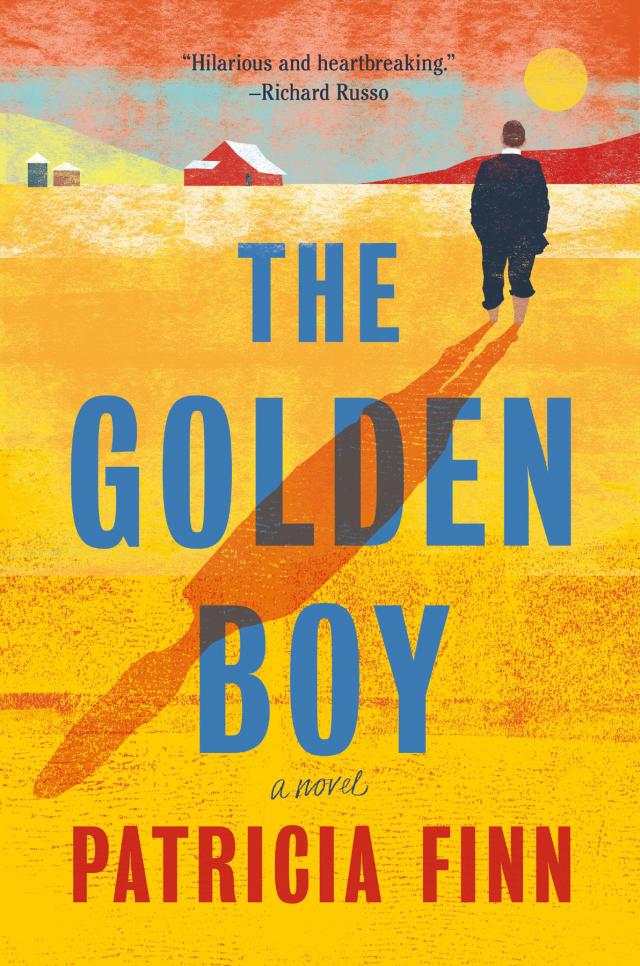


But soon he would roll over onto his side, careful not to drag the pale, silky sheets with him. He would draw his legs up close to his stomach and wrap his hands around his knees, and then he would cry into his pillow until it was wet and stained with the salt of his tears. And as he wept, the sound of the birds would gradually subside with the arrival of another day, and Stafford would stop crying and slowly swing his legs around to the floor and sit up. His wife would stir and stretch a hand toward him, resting it on the small of his back. She had beautiful hands, he thought, because they were not like the rest of her, which had become beautiful in the same carefully curated way her friends were. Only her hands had remained unchanged, and in them he could see the last vestige of who she had been and why he had once loved her. The square palms and straight fingers with the round nails.
When they were very young, he had once taken her hands into his own and kissed them and told her that his mother said a woman’s hands should look good with a potato in them. She had laughed with him then, and he remembered spending that weekend making love to her in a bed too small for two, with a sheet that wrapped around them like a shroud.
“What time is it, Stafford?”
“It’s early. Go back to sleep.”
“Is it nice out?”
“It will be.”
“Tell Kelly to start in the kitchen.”
“Today? She comes today?”
“It’s Tuesday, Stafford.”
“I thought she came on Fridays.”
“And on Tuesdays.”
“Right.”
“What time is your golf game?”
“Jim canceled.”
“That’s too bad.”
“I’ll bring you coffee later.”
“Don’t let me sleep too late, Stafford.”
On Maui there is a light that comes over the hills of Kapalua at dawn and again at nightfall that gives the green slopes that tumble down to the sea the soft glow of velvet. Dark rows of Norfolk pines mark the ridges of these grassy hillsides, some of them edging the roads that weave their way up from the sea. From the top of the ridge, where Stafford’s house stood, the views west toward the islands of Molokai and Lanai were, he felt, more manageable in the early-morning light, the great shimmering mass of water that filled the horizon somehow easier on the eye. There were hidden and unseen swells that moved beneath the surface of the water, but from the top of Stafford’s hillside, when the light was soft, there was no sign of movement. It would change later, he knew. The light would change everything, and the wind would pick up by midmorning, after which there would be no holding back, no lingering reserve from the pale-blue sea that surrounded him.
There was an outside kitchen and an inside kitchen, both attached to the main house. There was another kitchen inside the pool house, and a fourth one on the far side of the swimming pool in the little pavilion that served as a bar shack for drinks. It was here that Stafford kept everything he needed for his predawn breakfasts. He liked tea in the morning, preferring it to the coffee his wife insisted on drinking later and throughout the day. It was the tea his father had drunk, a tea that once came with small china birds inside the box—robins and sparrows for the most part, but the occasional blue jay and, once, a red cardinal. It was an advertising gimmick popular at the time, an easy ploy designed to sell ordinary tea to ordinary people. It lasted a few years and then the magic faded and the birds stopped coming.
Still, Stafford was never able to open a box of his father’s tea without a fleeting hope he might yet find a little tea-bird inside, dusty and wayward from the long journey. He had collected them when he was a boy, lining them up on the windowsill in his room and naming them, gluing their broken beaks back on when they fell, and moving them to safety when the window was open and the wind blew in from the fields. But that was long ago, when he was still living on a Canadian farm, surrounded by the long winters and straight roads that led to other farms and other boys. The tea-birds of his boyhood were gone.
“Stafford, it’s me. It’s your mother. Stafford, wake up.”
“I’m sleeping.”
“It’s already afternoon. It’s three o’clock in the afternoon, Stafford.”
“Go away.”
“The Shepherds came by again. They want to see you.”
“Tell them I’m sick.”
“They’re worried about you, Stafford. Everyone’s worried. They came by last night and again this morning. They said they’d call again after supper.”
“I don’t want to see them. Keep them away from me.”
“Stafford, it’s no good going on like this. You’re not a little boy anymore. You have to pull yourself together.”
“I don’t want to see them!”
“Crying won’t bring him back, Stafford.”
“Don’t you think I know that? Don’t you think I know?”
“All right, all right, don’t go all crazy again. I’ll tell them you’re sick. I’ll tell them you can’t see them just yet.”
Stafford Hopkins liked a cup of strong tea in the morning, and he steeped it in a tin cup that had to be held carefully because the handle was broken, and the cup grew hot quickly and burned his fingers if they brushed against it. He thickened the tea with condensed milk and then added three lumps of white sugar, stirring carefully until the sugar dissolved. And when he was satisfied with the color and thickness of his brew, he took the cup and walked to the far edge of his property where the outer stone wall dropped into the hillside below. And there he drank the tea, the sun rising over the house behind him, taking away the coolness of dawn and the mysteries of childhood like an inhaled breath of air.
“We are lost people, both of us lost,” he said to his wife at the start of their exile. “And the best place to be lost is paradise.”
“Oh, for Jesus’ sakes, Stafford,” she said. “Get a fricking hobby.”
CHAPTER 2
Games
In the Olympic Games it is not the most beautiful and the strongest that are crowned, but those who compete.
—Aristotle, Nicomachean Ethics
HOLLYWOOD LIKED STAFFORD’S WIFE. She was quick and fun and smarter than they gave her credit for, but that, of course, was the source of her charm. She didn’t need to be the star in the room. She was happy to let others shine and could adjust easily to the level of the other person, which was usually a notch or two below her own. But sometimes Stafford would watch Agnes as she took hold of the room and cast her charming spell over its inhabitants, and he would be suddenly anxious because he knew there was a ferocity within her that she could not always control. She was too easily wounded by uncertainty, and whenever happiness arrived or left, it did so like a great slam of a door, and he would see her face change from the girl he loved to a woman he feared.
None of this mattered when they were living in Canada, where they were generally shunned by the remnants of Stafford’s family, who disliked her for reasons of their own. But in Los Angeles, the deficiencies in her character ran the risk of derailing Stafford’s success in network television, without which they would not have been approved for membership at the prestigious private golf club they had waited six long years to join.
They were in their late thirties then, and her excitement was infectious. They were doing so well, the two of them. It was astonishing to think of who they were and where they had come from. But he was good at his job, wasn’t he, just wonderful at it, and they were both already certain he was being groomed for the top job. Their daughter was still small and the trouble there hadn’t started yet, and they had just bought the big house in Bel Air, and the money was pouring in, just pouring. She had learned to make martinis and host successful dinner parties, and their house had acquired the clean, sophisticated style that was expected of people in their social position. And now, a club. A private club. It was almost too much.
“Our first club!” she kept saying, like a dishwasher offered a seat in the dining room. “So when can we go? Will I need golf shoes?”
“‘Go’?”
“Play.”
“You’ll need lessons. A lot of them.”
“Oh, how hard can it be? I’d rather just go out and whack at the ball my own way. See how it feels. Nobody needs to see me, do they? Couldn’t we find a quiet day and play a few holes together, Stafford? You can show me what to do. It’ll be fun.”
“It’s not that simple,” he said, and he tried to explain to her that golf was an intricate, metaphysical game. That it was more than “whacking at the ball.” There were subtle social nuances, codes of conduct, and volumes of unspoken rules, all of which contributed, at different levels, to the complex etiquette of a wonderful game. Furthermore, he told his wife, playing golf at the level expected by the country club he had just paid six figures to join did not lend itself to her approach. You were expected to understand the game before you set foot on the links, and unless she was prepared to get serious and take some lessons and approach golf with the respect it deserved, he did not see any point in maintaining her membership as anything other than a social one. So no, they would not be going out and “whacking at the ball” together at the Bel-Air Country Club.
“Fine, then,” she said, and her voice was bright and cold, and he knew his wife was in trouble, and that meant they would fight, and it would be vicious from start to finish the way their fights always were. “Put me down for a social membership. Put me down for dining room hostess if that’s what you think I’d be good at, and I can fuck the kitchen staff on my breaks.”
And then, as was so often the case in those years, her shoulders tightened, and her hands went up, fingers splayed, the palms facing him like a child waiting for a hit but not ready to duck.
“Here we go,” Stafford said. “It was just too good a day, wasn’t it?”
“Shut up!”
“So you had to wreck it.”
“You put me down. You always put me down!”
“Oh, I put you down. What crap. You did this to yourself.”
“I didn’t.”
“You did this. You’re doing this.”
“I hate you, Stafford. I hate you!”
“You’re doing it to yourself. You’ve been looking for a fight since you got up this morning. I knew it was coming.”
“You shit-fucker.”
“Don’t hold back, honey. Let it all out.”
“Shut up! I hate you! You and your shit-fucking golf etiquette.”
“Why don’t you yell a little louder so Callie can hear every word? I would hate for her to miss any of this. I’ll open the windows so the neighbors can hear too.”
“Fine! Open them. Tell everybody. I don’t care. I just don’t give a fuck, Stafford. You care but I don’t. I really don’t!”
In those days, Agnes was crude when she was angry, and when she lost control of her temper, she was unreachable. He did not understand why she found it necessary to overreact to everything he said, and he did not believe that he was responsible for her outbursts. He only wanted her to understand that they had moved into a social and business world where everyone was watched. You could not lose control in public unless you chose to—and then only because it was part of a style that you were consciously intending to assert. But the uncontrolled, verbally abusive rage that swept over his wife like a toxic gas frightened Stafford, and he often wondered if she was mentally ill. She called those moments her train wrecks, and afterward she would cry and apologize and promise him that she would not do it again and she would see her doctor to make sure her hormone levels were not just a little bit off or her thyroid medication in need of adjustment. She would get more sleep, and she would eat more raw vegetables, and she would stay away from yeast because one of the wives had told her that yeast had been linked to manic depression. Or was it cold sores? She was sorry. She was sorry. Sometimes she just lost it, and she couldn’t help it, but she would try. And she would take golf lessons and learn to play properly like the other wives of the other members and when she was good enough, she would golf with Stafford—surpassing him and everyone else at the Bel-Air Country Club with the natural talent of someone who could hit the ball in the right direction, invariably landing on or near the green next to the tiny hole marked by a flag she called the nipple.
“It’s like a breast, don’t you think?” she would say, dropping the ball into the hole with one easy putt. “The soft, round greens with the hole in the middle and all those golfers lined up behind us waiting their turn to latch on. I hated breastfeeding. Where to next?”
Stafford had learned to play golf at a public course in southeastern Ontario, built on a narrow strip of land between the highway and the new plastics factory north of the river. Unable to meet the membership requirements, Stafford and his friend Bobby would sneak onto the course late at night after closing time and play golf by moonlight and later by flashlight, drinking beer and smoking cigarettes as they drove the balls furtively down the rough fairways toward the crudely marked greens. Bobby was just beginning to lose hope that summer, but nobody would see this until later because the loss of hope is a gradual thing, like a waterline on a lake that changes from year to year until someone finally notices and says that the lake is high that year, or that it isn’t. Stafford had an inkling, though, that Bobby was unhappy but only in the way that other boys were unhappy then—frustrated with the milking and the hard work and the loneliness of living on a Canadian farm.
Stafford’s father had taken him into Napanee a few months before his fifteenth birthday and bought him a starter set of clubs and a plaid plastic golf bag to keep them in. It was November, too late in the year for golf, but all that winter, Stafford practiced in the barn until he could putt thirty feet in a straight line if he swept the floor clean and kept the barn cats from pouncing on the ball from the rafters, bored with the mice and one another. When winter ended and the snow finally melted into the fields, the local golf course opened and Stafford and Bobby went together to book a tee time, and it was then that Stafford had his first encounter with golf etiquette. You had to be sixteen to play the Napanee Nine, unless you were accompanied by an adult.
The new manager of the golf course was an asthmatic man named Bertram Feltzer, and since he had been fired by Stafford’s father the previous summer when he was caught stealing from the other hired men on the threshing crew, Stafford and Bobby knew that wheezing Bert was not going to look the other way when they said they were sixteen. They were both change-of-life babies, born to mothers well past forty, and their fathers were old men by the standards of the day and had no more time for golf than they did for tennis or cricket or polo. The problem, then, of finding a capable male adult to take them golfing was a significant one, and aside from Stafford’s older brother, Emmett, who was not capable, there seemed to be no options. They would have to play after hours, and since wheezing Bert was usually drunk by ten o’clock, they would not have to worry about being caught.
Bobby could not get away until after the evening milking, so their plan was built around the Shepherd cows and the shifting sensitivities of their lactic needs. Stafford went to bed early in the summertime because he liked to read, and his upstairs bedroom was cool when the window was open and the breeze came in off the fields. When Bobby arrived and threw clumps of dirt through the window and onto Stafford’s bed, Stafford would crawl out the window and slide down the sloping roof to the edge of the house, where he would hang by his arms before dropping straight to the ground next to Bobby and Bobby’s dog, who never barked and could find the golf balls when the moonlight and the flashlights and the keenness of human eyes failed. It took half an hour to run across the fields, the highway, and the train tracks that led to the town of Napanee. But after that, it was only a slow jog to the golf course, where Stafford and Bobby would climb over the fence behind the old trailer that served as the clubhouse.
And so it was that Stafford Hopkins, a Canadian farm boy of fifteen, learned all about the wonderful game of golf, he and poor Bobby Shepherd, and all between the hours of midnight and two a.m. It was the last full summer before Stafford’s father died, and there was the smell of the hay and the mosquitoes and Bobby’s old dog, Skidder. There was the drumming of the big trucks on their way east from Toronto and the singing of the night trains on the tracks that followed the highway between the town and the farms, trains that lit up the fairways of the Napanee Nine with their solitary beams of light.
“Mrs. Hopkins would like you to start in the kitchen today, Kelly.”
Stafford smiled at the woman, whom he recognized from previous encounters in the same way he recognized waiters and security guards.
“Yes, sir. Should I clean out the fridge too?”
“Is that what you usually do?”
“Mrs. Hopkins said I should.”
“Well then, you’d better do what the boss says, Kelly.”
Stafford winked and smiled a second time at the woman, who knew more about the inside of his fridge than he did. He was sitting at the kitchen counter in the main house, waiting for the coffee to brew, but he was not comfortable sharing the cavernous space with Kelly, so he picked up his glasses and his newspapers and left. His normal routine on most Maui mornings was to play golf on any one of the three world-class courses Kapalua was famous for. He played with a group of other wealthy retired men, men who no longer ran corporations and complex business empires but had settled comfortably into the third act of their lives with the same energy and enthusiasm that had carried them through the first two. Some of the men were remarkable in the way that Stafford had been, but most of them were the products of family dynasties started generations earlier by other remarkable men. Stafford was keenly aware of the difference, but it meant less to him now than it had when he was cutting his own way through the high grass. He knew that his wife would be golfing later with the wives of the men he golfed with. The women preferred a late-afternoon game that led into cocktails and dinner, while the men liked to golf as early as possible and then nap in the afternoon, falling asleep in chairs or on top of their beds, their mouths slack and open.






