The murderers ape, p.1
The Murderer's Ape, page 1
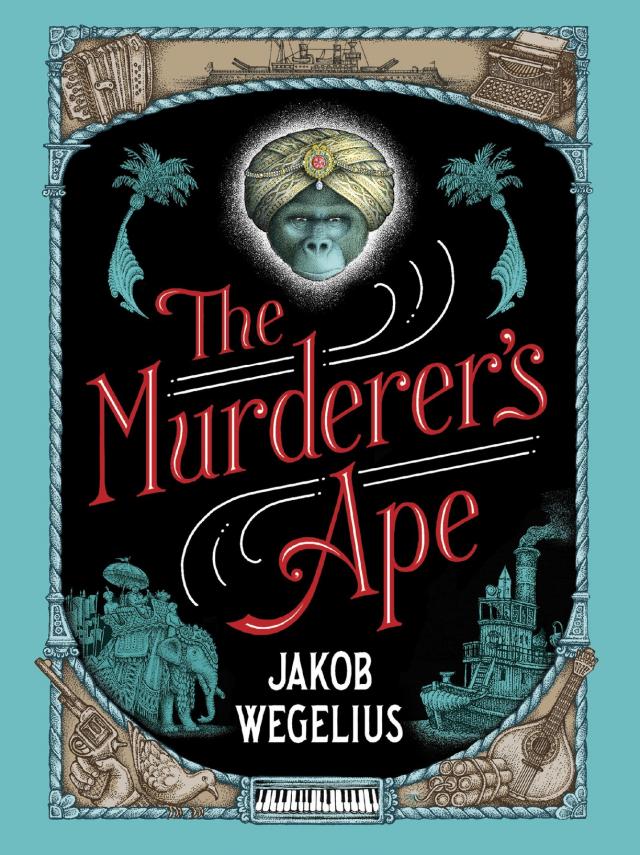


This is a work of fiction. Names, characters, places, and incidents either are the product of the author’s imagination or are used fictitiously. Any resemblance to actual persons, living or dead, events, or locales is entirely coincidental.
English translation copyright © 2017 by Penguin Random House LLC
Cover art and interior illustrations copyright © 2014 by Jakob Wegelius
Cover typography by Jim Tierney
All rights reserved. Published in the United States by Delacorte Press, an imprint of Random House Children’s Books, a division of Penguin Random House LLC, New York. First published in hardcover in the Swedish language as Mördarens Apa by Bonnier Carlsen, Stockholm, Sweden, in 2014. Mördarens Apa copyright © 2014 by Jakob Wegelius. Published in the English language by arrangement with Bonnierförlagen, Stockholm, Sweden.
Delacorte Press is a registered trademark and the colophon is a trademark of Penguin Random House LLC.
Visit us on the Web! randomhouseteens.com
Educators and librarians, for a variety of teaching tools, visit us at RHTeachersLibrarians.com
Library of Congress Cataloging-in-Publication Data
Names: Wegelius, Jakob. | Graves, Peter, translator.
Title: The murderer’s ape / Jakob Wegelius ; translated from the Swedish by Peter Graves.
Other titles: Mèordarens apa. English
Description: New York : Delacorte Press, [2017] | Summary: When her best friend, the sailor Henry Koskela, is falsely accused of murder, a gorilla named Sally Jones visits the run-down docks of Lisbon, embarks on a dizzying journey across the seven seas, and calls on the Maharaja of Bhapur’s magnificent court—all in an attempt to clear Henry’s name.
Identifiers: LCCN 2016010508 (print) | LCCN 2016037043 (ebook) | ISBN 978-1-101-93175-2 (hardback) | ISBN 978-1-101-93177-6 (ebook)
Subjects: | CYAC: Mystery and detective stories. | Adventure and Adventurers—Fiction. | Friendship—Fiction. | Gorilla—Fiction. | Human-animal relationships—Fiction.
Classification: LCC PZ7.1.W4292 Mu 2017 (print) | LCC PZ7.1.W4292 (ebook) DDC [Fic]—dc23
Ebook ISBN 9781101931776
Random House Children’s Books supports the First Amendment and celebrates the right to read.
v4.1
ep
Contents
Cover
Title Page
Copyright
Characters
The Typewriter
Part One
Chapter 1: Me, the Chief and the Hudson Queen
Chapter 2: Morro
Chapter 3: Agiere
Chapter 4: A Cargo of Weapons
Chapter 5: A Sorry Spectacle
Chapter 6: A Nocturnal Drama
Chapter 7: The Murderer’s Gorilla
Chapter 8: The Singing
Chapter 9: The Woman in the Window
Chapter 10: The House by the Nameless Park
Chapter 11: The Tram Inspector
Chapter 12: Signor Fidardo
Chapter 13: An Evil Premonition
Chapter 14: Days and Nights
Chapter 15: A Little Red Accordion
Chapter 16: Organs for the Dead
Chapter 17: The Werewolf on Rua de São Tomé
Chapter 18: The Present
Chapter 19: The Grave of Elisa Gomes
Chapter 20: Nights at the Tamarind
Chapter 21: The Hill Behind the Prison
Chapter 22: A Greeting from the Other Side
Chapter 23: The Far East
Chapter 24: Fabulous Forzini
Chapter 25: Farol Do Bugio
Chapter 26: The Viscount
Chapter 27: Purple
Chapter 28: The Bishop’s Conditions
Chapter 29: Cochin
Chapter 30: Song of Limerick
Part Two
Chapter 31: A Notch in the Blade
Chapter 32: Storm Winds from the Sahara
Chapter 33: Rue des Soeurs
Chapter 34: A Strange Beast
Chapter 35: The SS Minsk Goes Down
Chapter 36: Bombay
Chapter 37: The Malabar Star
Chapter 38: Karachi
Chapter 39: The Station Inspector in Jodhpur
Chapter 40: Delayed Meetings
Chapter 41: An Audience in the Durbar Room
Chapter 42: An Oath of Loyalty
Chapter 43: The Lord Chamberlain
Chapter 44: Recruited as a Spy
Chapter 45: Maji Sahiba
Chapter 46: Checkmate
Chapter 47: The Flying Maharaja
Chapter 48: Emergency Landings and Champagne
Chapter 49: A Deceitful Plan
Chapter 50: Sabotage
Chapter 51: Saudade
Chapter 52: An Unexpected Invitation
Chapter 53: Seven Hundred Pearls from Bahrain
Chapter 54: Tears of Joy and Some Light Refreshments
Chapter 55: The HMS Rana
Chapter 56: Ayesha
Chapter 57: Mattancherry
Chapter 58: Night in Jew Town
Chapter 59: Disappointments
Chapter 60: Playing for High Stakes
Chapter 61: An Exchange of Turbans
Part Three
Chapter 62: Reunions
Chapter 63: Waiting
Chapter 64: Familiar Handwriting
Chapter 65: The Telephone
Chapter 66: The Patient
Chapter 67: Alarm
Chapter 68: Tram Number Four to Estrela
Chapter 69: The Shot
Chapter 70: Footprints
Chapter 71: Inspector Umbelino and the Truth
Chapter 72: Uncle Alves
Chapter 73: Red Sails in the Morning
Chapter 74: Iron Gates
Chapter 75: The Great Scandal
Chapter 76: Letter from a Dead Man
Chapter 77: A Funeral Feast
Chapter 78: The Last Meal On Board
Chapter 79: Dynamite!
Chapter 80: Autumn Evening
About the Author and Translator
The other day the Chief gave me an old typewriter, a 1908 Underwood No. 5. He’d bought it from a scrap merchant down by the harbor, here in Lisbon. Several of the keys were broken and the release lever was missing, but the Chief knows I like fixing broken things.
It’s taken me a couple of evenings to mend my Underwood No. 5, and this is the first time I’ve written anything on it. Several of the keys still stick, but a pair of pliers and a few drops of oil will soon put them right.
That will have to wait until tomorrow. It’s already dark outside my cabin window. The lights from the vessels lying at anchor on the river are reflecting in the black water. I’ve strung my hammock and I’m about to climb into it.
I hope I don’t have those horrible dreams again tonight.
It’s evening again.
The Chief and I were lucky today. Early every morning we go to a harbor café where unemployed sailors wait round hoping to get work for the day. There is not usually anything much, but today we struck lucky and so we have been heaving sacks of coal from dawn to dusk. The pay was poor, but we need every penny we can earn. My back aches, my arms ache and my fur is itchy with coal dust.
More than anything else, though, I’m tired. I didn’t sleep well again last night. It must be at least a month since I had a full night’s sleep undisturbed by nightmares.
The same dreams return time after time.
Some nights I’m back in the engine room of the Song of Limerick. I’m being held from behind by strong arms while the engine is racing and the ship is sinking.
Other nights I dream of Chief Inspector Garretta. It’s dark and I don’t know where I am. Among the tombs in Prazeres Cemetery, perhaps. The only things I can see are Garretta’s small eyes, which shine with a cold gleam under the brim of his hat. And I can smell the acrid gunpowder from his revolver—the shot is still ringing in my ears.
The most horrible dream is the one about the Chief. I am standing in the rain waiting for him outside an iron gate in a high wall. Time passes and I’m chilled to the bone. I try to convince myself that the gate will open at any moment, but I know in my heart that I’m fooling myself. It’s never going to open and the Chief is caught behind that wall forever.
There are times when I scream in my sleep. One night not long ago I was woken by the Chief rushing into my cabin waving a big pipe wrench. Hearing my screams, he’d thought someone had crept aboard and was going to hurt me. That was a distinct possibility, for we’ve made dangerous enemies in Lisbon.
I’m too tired to write any more at present. I’ll probably write again tomorrow. I’m really pleased with my Underwood No. 5!
It’s foggy tonight. It came rolling in from the Atlantic during the afternoon. I went up on deck just now and couldn’t see beyond the cranes a short way along the quay. Every so often the gruff noise of foghorns and the ringing of ships’ bells can be heard from the river. It sounds a bit ghostly.
The Chief and I have been carrying sacks of coal again today. I was thinking about my Underwood No. 5 while doing it, and now I’ve decided what I’m going to use it for.
I am going to use it to tell the truth.
The truth about the murder of Alphonse Morro.
So that everyone knows what really happened.
And maybe the writing will help to rid me of my nightmares.
For those of you who don’t know me, the first thing I need to say is that I’m not a human being, I’m an anthropoid ape. I’ve learned from scientists that I belong to the subspecies Gorilla gorilla graueri. Most of my kind live in Africa, in the thick jungle along the banks of the Congo River, and that’s probably where I originally came from.
I don’t know how I ended up among people, and I probably never shall know. I must have been very small when it happened. Maybe I was caught by hunters or by natives and they then sold me on. My very first memory is of sitting on a cold stone floor with a chain round my neck. It may have been in the city of Istanbul, though I can’t be completely certain.
Since then I’ve lived in the human world. I’ve learned how you human beings think and how to understand what you say. I’ve learned to read and to write. I’ve learned how people steal and deceive. I’ve learned what greed is. And cruelty. I have had many owners and I would prefer to forget most of them. I don’t know which of them gave me my name. Or why.
But I’m called Sally Jones anyway.
Many people think the Chief is my present owner, but the Chief isn’t the sort to want to own others. He and I are comrades. And friends.
The Chief’s real name is Henry Koskela.
We first met many years ago when I stowed away on a freighter called the Otago. The crew found me, and the captain ordered them to throw me overboard. But the ship’s chief engineer stepped in and saved my life. That was the Chief, that was.
We chanced to meet again a couple of years later in the harbor district of Singapore. I was seriously ill and standing chained to a post outside a sleazy bar. The Chief recognized me and bought me from the bar owner. He took me with him to the ship he was working on and gave me food and medicine. That was the second time he saved my life.
When I eventually recovered I was allowed to help the Chief with various little jobs round the engine room. I liked the work, and thanks to the Chief I became good at it too. Everything I know about seamanship and ships’ engines I’ve learned from him.
We’ve stuck together ever since, the Chief and I. From Southeast Asia we worked our way to Australia. We bought our own steamer, the Hudson Queen, in New York and ran her along the coasts of the Americas, Africa and Europe with various cargoes. We were our own masters and made enough money to keep the ship in good condition.
It was a good life, impossible to imagine a better one.
I hope it can be like that again.
Just under four years ago everything changed. That’s when our misfortunes began. The Chief and I had been sailing in British waters the whole of that summer, and when autumn arrived we decided to head for warmer latitudes to avoid the winter storms in the North Sea. In London we took on a cargo of tin cans bound for the Azores, a group of islands in the middle of the Atlantic.
The journey went well at the start. We had good weather and gentle winds, but our luck ran out early one morning when we collided with a whale. The whale survived, but the Hudson Queen took such a thump that her rudder was bent. While we were trying to mend the damage, the weather changed and a violent storm blew up. The Hudson Queen drifted helplessly, and if it hadn’t been for the drag anchor we’d have been lost. It was only once the wind had eased that we managed to rig emergency steering, set a course for the Portuguese coast and seek refuge in Lisbon.
Once we had unloaded our cargo, the Hudson Queen had to go into dry dock for rudder repairs. That took a fortnight and cost all the money we had saved. The Chief went round all the shipping agents in the port, trying to arrange a new cargo, but he found nothing. The quayside was already lined with freighters with empty holds waiting for better days.
The weeks passed. It’s never much fun to be stuck ashore, but there are worse ports than Lisbon to be stuck in. We used to spend our Saturdays riding round the city by tram. You won’t find smarter trams than Lisbon trams anywhere in the world, not even in San Francisco.
Our mooring in the harbor was below the Alfama district, a poor quarter of the city, sleepy by day and full of danger by night. No one batted an eye at the Siamese twins who sold shoelaces on Rua de São Pedro, nor at the Devil Dancers from the Pepper Coast who were to be found in the darkest alleyways when the moon was waning. In Alfama they didn’t even bat an eye at an ape in a boiler suit, and that was good for me.
Most evenings we went to O Pelicano, an inn used by many seamen when they are in Lisbon. It’s on Rua do Salvador, a dark and narrow lane rarely reached by the rays of the sun. The owner was called Senhor Baptista. He used to be a cook on the ships of the Transbrazil line and he always offered his guests a glass of aguardiente before they ate. Aguardiente is a sort of brandy, so I usually took a glass of milk instead.
I have many good memories of our evenings in O Pelicano, but I have a bad one too. Because it was in O Pelicano that we first met Alphonse Morro.
The Chief and I had been working late in the engine room of the Hudson Queen. I remember it was raining hard when we went ashore to have supper. The light from the gas lamps round the harbor was glinting off the wet paving stones of the quay, and dirty water was gurgling in the gutters and street fountains in the narrow streets of Alfama.
It was warm and smoky in O Pelicano. The regulars were squeezed in round the circular tables and several of them greeted the Chief and me with a wave or a nod. There were seamen and stevedores from the harbor, hollow-eyed streetwalkers and sleepless musicians. A big woman in black called Rosa was singing a fado about unlucky love. Fado singers are typical of the poor districts of Lisbon.
One of the guests was a man I hadn’t seen before. He was sitting on his own at the table nearest the door, and he looked up from his coffee as we entered. He had a narrow, very pale face, and his eyes shone black under the brim of his hat. I sensed that his eyes followed the Chief and me as Senhor Baptista showed us to an empty table in the innermost corner of the inn.
Senhora Maria, Senhor Baptista’s wife, served each of us a bowl of tomato soup and bread. We had just started to eat when the solitary man by the door stood up and came over to our table. I thought he must have been waiting for us.
“My name is Morro,” he said in a low voice. “I hear that you have a ship. And that you need work.”
At first the Chief looked surprised, then he looked pleased.
“You’ve hit the nail on the head,” he said. “Take a seat.”
The man called Morro threw an anxious look over his shoulder and sat down.
“There are some crates,” he said in a voice so low the Chief had to lean forward slightly to hear him. “They need to be picked up in Agiere, a small port on the River Zêzere. I have a map here.”
From his inside pocket Morro produced a folded map and spread it on the table. The Chief studied the map carefully. I realized that what interested him was the depth of the river.
“It’s rained a lot in recent weeks,” Morro said. “The water level of the rivers is high. You don’t need to worry about running aground.”
“That will depend on how heavily laden we are,” the Chief said. “How many crates are we talking about? And what’s in them?”
“Azulejos,” Morro said. “You know, ceramic tiles. There are six crates, and each crate weighs about six hundred fifty pounds.”
The Chief looked surprised.