

Nightshift, p.1
Nightshift, page 1


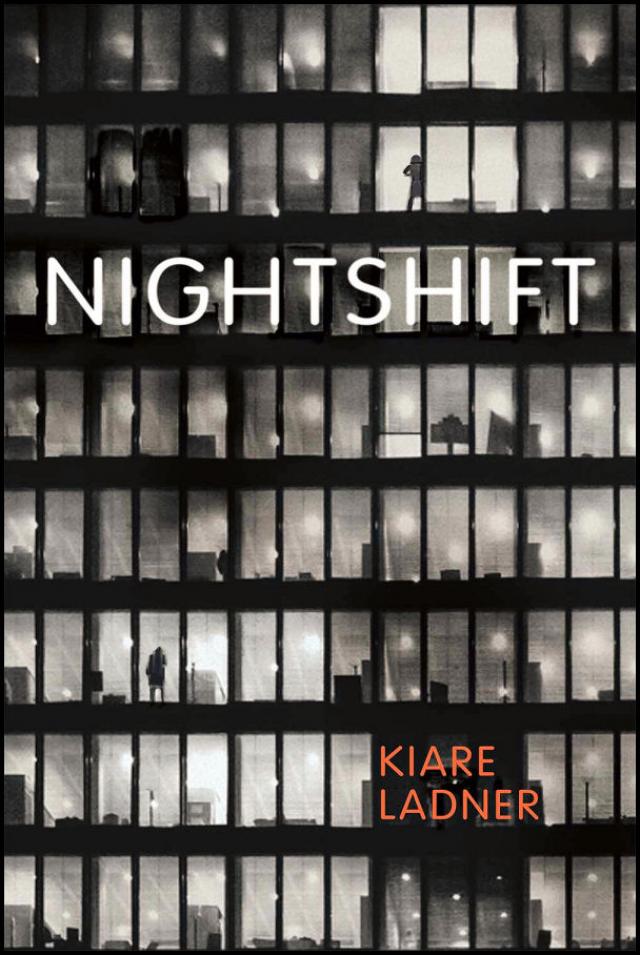
Kiare Ladner
NIGHTSHIFT
Contents
PART I
1
2
3
4
5
6
7
PART II
8
9
10
11
12
13
14
15
16
17
18
19
PART III
20
21
22
23
24
25
PART IV
26
27
28
29
30
31
32
33
34
35
36
PART V
37
38
39
40
41
42
PART VI
43
44
45
46
ACKNOWLEDGEMENTS
For Greg
Some are Born to sweet delight,
Some are Born to Endless Night.
WILLIAM BLAKE
PART I
1
At its peak my obsession with her was like a form of self-harm: a private source of pain and comfort.
When I found the ring box in the back of the drawer, I didn’t want to open it. Navy and heart-shaped, it has a finely brocaded border and thin silver hook. The lining is pearly satin indented to hold a delicate jewel. A market seller provided it for a sard ring I’d bought, shoving the chunky band determinedly into the slot. I could’ve saved him the trouble; I’d no need for the box, yet was captivated by its fairytale charm. On leaving the stall, I slid the ring onto my finger and smoothed the satin back into a tight clasp.
For almost two decades, I haven’t looked at what’s inside the box. Simply having it in the room will hopefully pull me through my task. When doubts hover close, I move it about restlessly. I place it behind my computer as if its reliquary power can channel through the screen, or hide it far away on the windowsill by the mouldy coffee cups. Getting up from my desk, I pace the room with it in my palm.
Since being unable to sleep, I’ve passed through a shadow curtain. The present has become dark and stagnant; the past circles vividly around me. Sharp memories cut through chronology’s thin skin. In the strange energy of these insomniac nights, I have begun to write as consolation. To make a story that will put an end to reliving flash fragments, to remembering only the most troubling details.
Easily, I slip back to the day I first saw her. I had a job in media monitoring; we provided clients in cars and construction with daily updates of press content. The articles were selected by senior analysts; my work was to write the summaries. Given that copying out the opening paragraphs brought no complaints, I wasn’t motivated to do much more.
Excused from staff meetings due to client deadlines, I’d twirl about in my office chair. Shutting my eyes, I’d picture the second floor, open plan and strip-lit. The boards separating cubicles decorated with photographs of loved ones, families and pets. One neighbour’s neat line-up of sharpened pencils, another’s orderly stack of camomile and fennel teas. My desk strewn with tyre-related articles, my board pinned with ideas for me and Graham, my boyfriend. The drawn conference room blinds meant I didn’t need to picture my conventionally dressed colleagues. Who were, in turn, spared the sight of me: a woman in a bobbly jumper and jeans with a mid-length tangle of orange hair.
No matter how often I played the game, when I looked again my surroundings would be both as I’d visualized them, and not. The concrete materiality of the objects was identical but the colours, the quality of light, the atmosphere were subtly different. See, I’d tell myself, you don’t know it all. Things change. You can’t predict how they’ll seem in thirty seconds, never mind till the end of time.
One August morning with sixteen months to the end of the twentieth century, I was more wrong than usual. When I blinked back into the room, a new person was seated opposite me. She didn’t appear to have noticed my twirling around in Megan Groenewald’s world – but while I’d have noticed her anywhere, in east London suburbia she was like an exotic zebra fish that had swum off course.
She wore a short, black-and-white, Bridget Riley-type number. Her build was lean, long-limbed and coltish; her hair was a shallow sea of inky curls. She had fine, straight features and close-set blue eyes so dark as to glint like pitch. I wanted to introduce myself but the cords that looped from her ears to her Walkman put me off.
Since she was typing like a demon on her keyboard, I flamboyantly increased my own speed. When my document contained more errors than words, I glanced at her. She lifted her head; she had a slight squint.
‘I’m Meggie,’ I said.
‘I’m Sabine.’
‘What are you listening to?’
She took her earphones out. Her hands trembled as she passed them over to me; her nails were bitten to such small tabs that her fingers seemed entirely made of skin.
Surprised she didn’t mind me sticking her earphones in my ears, I listened. An expressive male voice sang tenderly to a sweeping accompaniment. Wiping them off with my thumbs before handing them back, I said, ‘I like it.’
‘It’s “La Chanson Des Vieux Amants” by Jacques Brel.’
‘Are you French?’
‘Belgian. Jacques Brel is Belgian.’
‘No,’ I said. ‘Are you French?’
‘Belgian,’ she said, ‘but yes.’
Then she added, ‘Also German, Jamaican, Jewish, Egyptian. It’s a long story—’
‘You don’t have to go into it.’
‘Thank fuck. I hate this question.’
‘People ask me all the time too.’
She frowned. ‘If you’re French?’
‘No, where I’m from. When I say, South Africa, they say, Don’t you miss the weather? I wish I could press a button to answer them.’
She cocked her head to the side, biting her lip. ‘You are how old?’
‘Twenty-three.’
‘Me too.’
We looked at each other.
‘I don’t know much about Belgium,’ I said.
She shrugged. ‘It’s flat. How about South Africa?’
‘Parts are flat, parts are mountainous. Growing up there in the eighties . . .’ I hesitated; she waited. ‘I knew things were wrong. I felt it as a child. But I didn’t fully understand. Now I do but I’m here.’
What was I getting at? Speaking about this could be awkward. The music from the earphones in Sabine’s hand had changed to a tune with a strong beat.
‘It’s complicated,’ she said.
I nodded. Ten minutes later, an apple jelly bean clipped my shoulder. When I looked up Sabine had popped her earphones back in. Her English was almost perfect; the tone of her voice was mesmeric and low. I sucked the tart sweet slowly.
For the rest of the day, I imagined conversations in which I said the things I wished I had and asked the things I wanted to know.
2
Sabine wasn’t a big talker and my fantasies of meaningful conversations stayed no more than that: fantasies. If she’d hinted at intimacy in our first chat, she rebounded from it afterwards. Yet had she distanced herself from me consistently, I’d have lost interest. Instead, right from the start, there was a push and pull between us. We had moments of sudden openness, affinity even, and their promise kept me hooked.
Many of our exchanges centred on food. Every day Sabine brought in a cooked dinner. She put it in the fridge in the morning. At lunch, she heated it in a pot on the hotplate. By the time she ate at her desk, the whole floor smelled of her meal.
One day, the MD and the HR director came to our office for a meeting with clients. As they left, the MD wrinkled his nose and looked around. Sniffing suspiciously, he walked down the aisle between the desks.
He stopped when he got to Sabine. ‘That smells delicious.’
‘It’s cuisse de canard confite,’ said Sabine.
The HR director said hastily to the MD, ‘I sent round an email, and we removed the microwave. She must have used the hotplate—’
‘Duck leg?’ the MD said.
‘Candied,’ Sabine said. ‘Would you like to try?’
‘Don’t mind if I do.’
She took a plastic fork from next to her takeaway coffee mug and gave him a taste.
He chewed slowly, swallowed and nodded approvingly. ‘Takes me back to a fabulous meal I had at the George Cinq Four Seasons Hotel.’
‘I know it,’ said Sabine.
‘Are you from Paris?’
‘No, but I lived there. I worked near the Four Seasons.’
‘What work did you do?’
‘I was with Crazy Horse. You have heard of them?’
The MD looked goggle-eyed.
I put Crazy Horse into Internet Explorer.
One of the secretaries called the MD to the phone. ‘Wonderful to meet you,’ he said to Sabine. ‘Next time you’re at our Victoria offices, drop in for a chat.’
According to the internet, Crazy Horse was an upmarket strip show.
After the MD and the HR director had left, I said to Sabine, ‘Wow. You made an impression.’
She shrugged and put some more duck leg in her mouth.
I said, ‘Working at Crazy Horse must have been quite something.’
She seemed to be studying me. She took a long, slow sip of water.
Then she said, ‘I never worked at Crazy Horse.’
‘You didn’t?’
‘No,’ she said. ‘But now I get to heat my cuisse.’
Another day, Sabine was late with her meal. When I went into the kitchen, I noticed her shadow on the wall; it was slinky and elongated, like an Aubrey Beardsley sketch. She was wearing a peacock-patterned halterneck dress; all she needed were some feathers in her hair.
While she stirred a rich black ale, onion and beef stew with a wooden spoon, I asked, ‘If you weren’t at Crazy Horse, where were you before here?’
She stuck a finger in the pot to test it. ‘Sunset Strip.’
Sunset Strip in Soho was known for being a more empowering strip joint. For having women-only nights too. I’d read about it in a London listings magazine. I could easily imagine Sabine there but I said, ‘You’re lying!’
She smiled.
‘Seriously, what were you doing?’
‘Baking bread.’
‘You’re just saying that.’
‘Why would I just say that? Baking bread is cool. You work through the night. You play loud music. You take drugs. You go for drinks in the morning—’
‘So why did you stop?’
‘The head baker was hassling me. It was a small town by the sea, the kind of place you can’t get away from somebody. One morning I left and didn’t go back. In London, it’s easy to disappear.’
‘Sure,’ I said. ‘But, why media monitoring?’
She lowered the hob’s dial. ‘Why did you choose it?’
‘I was staying with family friends in Telford. Doing a crap job—’
‘Like this, then.’
‘Crapper. For a company on an industrial estate that bashed out dents in cars. I answered the phones all day. Dent Mend and Paint Repair 01952 746—’
‘You remember the number?’
‘On my deathbed, it’ll still be going round my head.’
She laughed.
‘Telford wasn’t for me,’ I said. ‘I grew up in a parochial town.’
‘Meaning?’
‘Narrow, insular. Once, they had a beauty contest in a shopping mall. Anyone could go on the platform, enter themselves. The crowd booed or cheered. If they booed, you came down again. The audience was mostly black people but the winner was a ghostly blonde in a settler’s dress. And her prize was . . .’
‘Yes . . .?’
‘Two cartons of cigarettes!’
‘No wonder you’re done with towns,’ Sabine said. ‘But how did you end up here?’
‘The people I was staying with knew someone in media monitoring. They thought it’d be better than temping. How about you?’
She scooped her stew efficiently onto a plate. ‘The day I saw the ad in the papers, a psychic told me Ilford was in my stars.’ She licked the spoon, then shrugged. ‘Who am I to fight destiny?’
Usually I came into the office earlier than Sabine and left before she did. But one afternoon, I hung around. I’d thought of asking her for a drink; if we left together, the conversation might head that way.
As she packed her Tupperware into her lime manga rucksack, I said, ‘Your food always smells intriguing.’
‘What do you mean?’
‘Smells good. What was it today?’
‘Moroccan tagine.’ She pulled the drawstring closed.
Tossing my small denim handbag over my shoulder, I followed her to the lift. ‘I’d love to go to Morocco,’ I said.
‘I went with my lover once,’ she said.
‘Lucky you.’ I wondered if it was a woman or a man.
The lift arrived, empty.
‘And lucky him,’ I tested.
‘Lucky her,’ she said, giving me a look as she stepped inside. She pressed the button. ‘We went to Fez. It is like in the fourteenth century. We stayed in a palace with an old pool.’
‘I’m jealous.’
The lift descended.
‘Fez is a sensuous place,’ she said. ‘You walk in the medina. You go through the dark alleys. You get lost. Around one corner there are perfumes, these perfumed stones the women rub on themselves. Around another corner, you see a tannery, you smell the piss they soak the skins in. And around another corner, you go through a side door into a marble palace.’
I stared at her in wonder.
The lift doors opened.
‘I’ll send you the recipe for the tagine,’ she said.
3
If Sabine’s talk was elusive, it seemed to me free; if it was fanciful, it fed my image of her as a brave heroine in a dark fairy tale. I was awed by her ability to be herself – unconventional, uninhibited – where I’d never had the courage to do the same.
Negative space is the lifeblood of obsession. In the late nineties, I felt as if I was mostly negative space. Although I wasn’t the daughter my mother wanted, I’d never had the guts to rebel. She said I was like my father: passive, meek, defined more by what I bumped up against than what I chose.
An English lecturer, romantic and dreamer, my father was killed in a car accident when I was two months old. Before his death, my mother was a professional ballroom dancer. The way she told it, she’d had tremendous potential. But finding herself a widow with an extremely demanding baby, she gave it up. Taking out a loan, she opened Renata’s Roses & Blooms. She hired a trained florist, Thandi, who did most of the work.
My mother’s many unquestioning acolytes regarded her as a sparkling force of nature. She could be charming, creative and charismatic. But she also had a deep store of anger within her. In public it occasionally darkened her face, though the thunderclouds only broke when she had me to herself. Unfortunately, with it being just the two of us, this happened often, her fury shaking our tin-roof house as loudly as a pelting of hail.
The outbursts would be followed by tearful apologies. Then by platitudes that made no sense. Then by suggestions of renewed intimacy that I had to comply with if I didn’t want the anger to return. Huddled under her sunshine quilt, I’d be asked to tell all, in particular about boys. It took many naive confessions before I realized that our intimacy depended on my being the person she wanted me to be, not the person I was.
After I failed the law degree my mother expected to lead to a solid career, or at least a distinguished lawyer husband, I escaped to the UK. As a child, I’d buried myself in books; the wasted years spent trying to memorize legal cases, I’d had no time to read, but in Telford I began to crave fiction again. I longed to lose myself in other lives, to feel the pulse of other worlds.
Yet the impetus to register for a part-time English literature degree came, unexpectedly, from cocaine. A guy at Dent Mend gave me a tiny ‘takeaway’ to try at home. I made three dots (there wasn’t enough for lines) to share with my hosts’ sons. We claimed it had no effect but late that night, sleepless and bursting with bravery, I filled in the registration forms.
I’d assumed that my father’s genes would breeze me through the course. But to my surprise, studying a subject I thought I’d love didn’t come easy. Getting a grip on theoretical arguments was tough. Nonetheless, I persisted in organizing my life around it.
In a leafy south London suburb, I took a room in a houseshare that was private, professional and quiet. Nights I didn’t stay over at my boyfriend’s, I got up at four a.m. to work. After scraping through Post-colonialism (just), I moved on to Victorian Gothic. But I was a slow reader, a distracted thinker; when I came across lines I liked, I’d mull them over for hours . . .
Despite my approach leading to flights of fancy rather than academic completion, I kept thinking I had to seep myself in the spirit of the books. Buying black taper candles on my lunch break, I bumped into Sabine. I told her of what I was trying to do. Later, she burned me a death metal album by Gorguts called Obscura.
‘This,’ she said with authority, ‘will definitely help.’
4
One autumn morning, I sat in the light of my black candles attempting to write an essay on Dr Jekyll and Mr Hyde. After two hours of getting nowhere with Gorguts in my ears, I decided to go in early to work.
Sabine had been off all week with the flu, and I’d volunteered to write her summaries. ‘Don’t bother telling the client,’ the manager said. ‘Just do them as if you were her.’ I affected her excellent posture as I typed in her passwords (XaviToujours, lemortlemort87) and signed off her emails Sabine Dubreil.






