The Dark Lady

The Dark Lady

Louis Auchincloss

Louis Auchincloss

The offices, penthouses, and suburban chateaux of New York are the setting for Louis Auchincloss's The Dark Lady. Spanning three decades from the 1930s to the McCarthy era, the novel chronicles a powerful woman's rise and the human toll it exacts.In a world where birth and style count nearly as much as wealth, Elesina Dart is supremely equipped to star. Lovely, well-born, bright, even moderately talented as an actress, Elesina seems perversely bent on canceling out these advantages. After two destructive marriages and an affair with alcohol, she is close to low ebb when Ivy Trask takes heron. Ivy's business is the exercise of power, as editor of the fashion-arbitrating Tone magazine and in her own loveless life. In Elesina, she finds material worthy of her best efforts.Stage-managed by Ivy, Elesina makes a widely successful and equally scandalous match with Judge Irving Stein, banker, connoisseur, collector — and old enough to know better, as all who are close to him point out. Mistress of Broad-lawns, living's Westchester estate, and caretaker of his fabulous art collection are roles Elesina takes in stride. Forall his riches and influence, Irving is a man of deep sensibility, a romantic — as is David, his attractive youngest son, whose passion for his stepmother leads to tragic consequences. Inevitably, husband, lover, and friend all fall victim to Elesina's need for the center stage, which she has come to see as her manifest destiny. In this major new novel, Louis Auchincloss examines the many faces of ambition and desire that rule both the schemers and dreamers of fashionable society. It is a story that only Auchincloss, with his exceptional knowledge and insight, could write.
Read online
  • 30
False Gods

False Gods

Louis Auchincloss

Louis Auchincloss

In this elegant collection of stories, Louis Auchincloss once again evokes the beguiling, complex world of New York society that he has made his own special literary landscape. Inspired by the colorful mosaic of ancient Greek myths, he has created six equally rich contemporary fables — six lives governed by false gods.Hermes, or in Auchincloss's ironic interpretation, "god of the self-made man," is a Jewish lawyer who finds acceptance into WASP society only at greatest personal cost; Hephaestus is a bachelor designer of Palladian villas whose young bride, enamored of newfangled things, compels him to "go modern." In other stories, a former World War II naval officer, guided perhaps by the goddess Athene, escapes a sinking cruise ship by disguising himself as a woman; and a Catholic convert, distracted by the muse Polyhymnia, is torn between his priestly duties and his worldly social and artistic ambitions.In every tale a unique moral sensibility holds sway, revealing how the pagan impulse may surface in the most unlikely and provocative situations, compromising even the noblest of spirits. Keenly insightful, flawlessly executed, False Gods is the work of a master storyteller, widely acclaimed as American society's most entertaining and intelligent critic.From Library JournalIn this collection of six novellas, Auchincloss writes of men under the influence of "false gods." Imbued with the spirit of ancient Greek myths, these modern-day tales subtly describe the effects of moral conflict and compromised values. The setting is New York City, the protagonists all upper middle class. In "Polyhymnia, Muse of Sacred Song," Reggie Turner (aspiring priest and son of a wealthy socialite) struggles with his contradictory spiritual and artistic temperaments. In "Charity, God of Our Day," Myron Townsend resigns from the family law firm in a fit of pique and embarks on a new life. He attains fulfillment as a fundraiser for the Staten Island Zoo but sacrifices other, more genteel aspects of his nature in his efforts. In "Athene, Goddess of the Brave," Alistair Dows escapes a sinking ship by disguising himself as a woman. Although not for all readers, these fables are finely crafted and eloquently written. Previewed in Prepub Alert, LJ 9/15/91.- Kimberly G. Allen, National Assn. of Home Builders Lib., Washington, D.C.Copyright 1992 Reed Business Information, Inc. From Kirkus ReviewsThe title of Auchincloss's latest fiction is a variation on his Golden Calves (1988), but his moral sensibility remains the same--an insider's understanding of the sins and vanities of upper- class Manhattanites. In these six stories, Auchincloss recasts Greek myth into contemporary fable--none of his errant protagonists are one- dimensional fools or miscreants, but good men led astray by anger, ambition, fashion, and other all-consuming passions. In Ares, God of War,'' a Virginia gentleman allows his antebellum sense of honor to degenerate into postwar revenge as an unethical New York lawyer.Hermes, God of the Self-Made Man'' is a tale worthy of the best Howells--a successful Yale-educated lawyer during the first half of this century sacrifices love, loyalty, and his identity as a Jew for his ambitions, all of which he justifies by his sense of victimization. In Hephaestus, God of Newfangled Things,'' a once- brilliant architect regrets the compromises he made in marriage and career. A crisis of faith underpinsPolyhymnia, Muse of Sacred Song,'' in which an asexual son of a society matron converts to Catholicism, only to abandon his vocation in a burst of Protestant doubt about Roman dogmatism. Charity, Goddess of Our Day'' examines the little-noticed (but perhaps greatest) vanity of the rich, and asks: Charity at what cost? A retired lawyer proposes a morally dubious estates scheme to a wealthy dowager, but is chastened by his own wife.Athene, Goddess of the Brave'' strikes a therapeutic note: a grown-up mamma's boy, plagued throughout his life by fears of unmanliness and cowardice, confronts his demons after a particularly humiliating event. In the great world of Auchincloss, the ends never justify the means, and the rich are held to the highest of ethical standards. This may not be a major addition to the author's oeuvre, but it's an always welcome message, delivered with grace and elegance. -- Copyright ©1991, Kirkus Associates, LP. All rights reserved.
Read online
  • 28
Theodore Roosevelt

Theodore Roosevelt

Louis Auchincloss

Louis Auchincloss

Theodore Roosevelt was a man of contradictions: a warrior who won the Nobel Peace prize, a wealthy man who battled corporate greed, a thinker who prized action more than words (but who wrote fine books himself). He was also, writes Louis Auchincloss in this lucid biography, an extraordinary leader, "a political idealist who had the wisdom to know that only by astute and well-considered compromise in our legislative process could he hope to see enacted even a fraction of the social and military programs that he deemed ... essential to the welfare of his nation." Compromise he did, of course, though in the end the war hero and trustbuster could not bring the right wing of the Republican Party to see the wisdom of his reformist ways. The result, Auchincloss chronicles, was a terrible split, bringing about the defection of liberals from that once-liberal institution and the birth of a political war that still rages. With a keen eye for political nuance and a clear appreciation for Teddy Roosevelt as a one-of-a-kind, self-made man, Auchincloss offers an engaging view of a great American president. --Gregory McNamee
Read online
  • 27
The Scarlet Letters

The Scarlet Letters

Louis Auchincloss

Louis Auchincloss

With such classic works as The Rector of Justin and, more recently, Manhattan Monologues, Louis Auchincloss has long established himself as one of our "most useful and intelligent writers" (New York Observer). Now this American master offers his cleverest novel yet: a triumphant modern twist on the legendary Hawthorne tale, in which secrets, sin, and suspense collide among the fabulously rich.The year is 1953, and the coastal village of Glenville, on the opulent north shore of Long Island, is shaken by scandal. Ambrose Vollard, the managing partner of a prestigious Wall Street law firm, gets word of an alleged affair in his family. Most astonishing, the adulterer is Rodman Jessup, Vollard's son-in-law, junior partner, and most likely successor. Until now Jessup has been admired for his impeccable morals and high ideals, so what could explain his affair with a woman of fading charms? All is on the line for Jessup, who threatens to upset Glenville's carefully calibrated social order. As each family member learns of the affair, the story reveals layer upon layer of abiding loyalties and shameless double-crossing.Wise, rich, and exuberantly entertaining, The Scarlet Letters posts a seductive missive to anyone ever tempted by power, wealth, or passion.From Publishers WeeklyAuchincloss's latest novel takes place in familiar territory-the world of the privileged classes in 1950s New York-and acquires extra resonance from its mirroring of Hawthorne's famous tale of guilt and redemption. The story opens with a scandal: respected New York lawyer Ambrose Vollard is shocked by the flagrant adultery of his favored son-in-law and heir apparent, Rod Jessup. The author then explores Vollard's rise from ignored son to head of his beloved law firm; his marriage to Hetty, the intelligent daughter of a Boston preacher; his indulgence of his favorite daughter Lavinia; and her relationship to the somewhat puritanical Rod, who is troubled by ghosts of the past, personified in the more hedonistic Harry Hammersly, his best friend and colleague at Vollard's law firm. When Vinnie and Rod divorce and she quickly marries Harry, the story-the battle between a too-strict moralism and a cynical disregard for right and wrong-is only beginning. Auchincloss's writing, which can seem somewhat old-fashioned and burdened with authorial exegesis rather than demonstration of character, makes perfect sense in the context of this near-allegorical morality tale, and readers are rewarded with an embellishment of the simple dichotomies of Hawthorne's novel with an appropriately ambiguous ending. The 1950s context allows the scenes of spiritual, sexual and legal corruption to have an impact they might not in a modern setting, and while the author makes apparent the force of personal history justifying each character's actions, it is always clear who the good guys and bad guys really are. This is a satisfying and sometimes surprising story from a past master of New York tales.Copyright 2003 Reed Business Information, Inc. From BooklistAmbrose Vollard has a successful career as managing partner of a distinguished Wall Street law firm and a useful marriage to the practical daughter of an old Boston family. The only thing lacking is a son, until his favorite daughter, Vinnie, marries Rod Jessup. But adultery destroys Vinnie's marriage, and change in the form of both her husbands--the honorable Rod and the less honorable Harry--undermines the old ways at Vollard Kaye. There is a sameness to Auchincloss' elegant tales of the Manhattan brownstone set, especially true in this novel, which is a reworking and expansion of a clever story in his 2002 collection, Manhattan Monologues. Some of the names have been changed; Ambrose was previously called Arnold Dillard. Some passages have been transplanted from the story word for word. But Auchincloss now provides more backstory, especially about Arnold--Ambrose, rather, and also takes his tale further into the future. In giving himself more scope to flesh out characters and examine shifting mores, Auchincloss sacrifices some of the story's original punch, but his many loyal readers probably won't mind. Mary Ellen QuinnCopyright © American Library Association. All rights reserved
Read online
  • 27
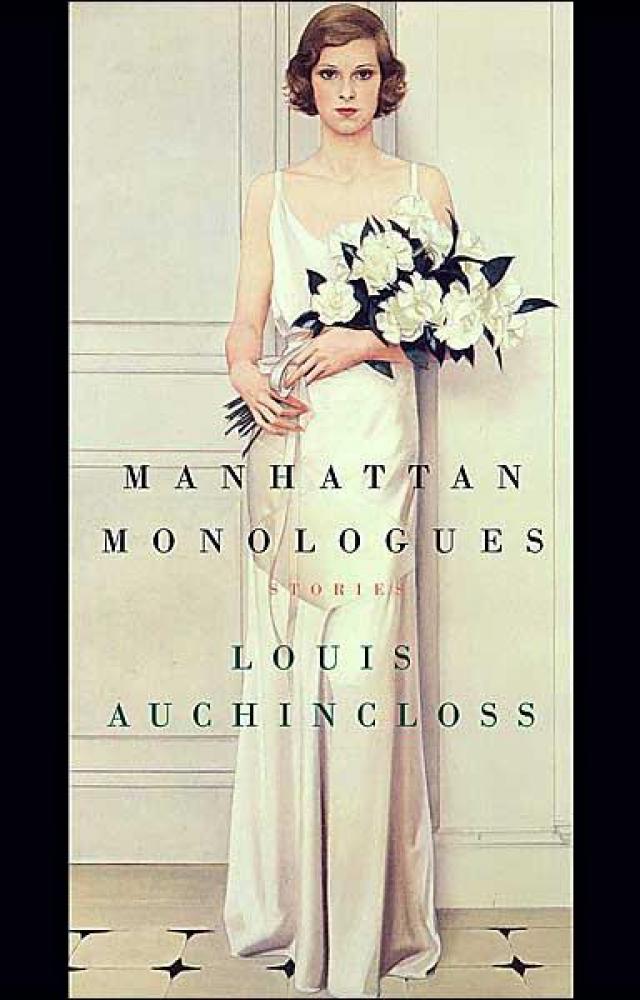
Manhattan Monologues

Manhattan Monologues

Louis Auchincloss

Louis Auchincloss

He is our sublime master of manners, our "most astute observer of moral paradox among the affluent" (Arthur Schlesinger, Jr.), and "one of the essential American writers" (Kirkus). Now, in his fifty-seventh book, Louis Auchincloss delivers a brilliant collection of ten new, previously unpublished, stories; once again, he unfailingly "voices truths with elegant precision" (Publishers Weekly).MANHATTAN MONOLOGUES charts a colorful New York century through a series of personal accounts from the rarefied circle that fills Auchincloss's best short fiction. Here are characters who confidently finesse their way through society's uppermost tiers and yet are just as easily undone by the smallest upset in a day. Like all of Auchincloss's richest creations, they bump up against their consciences, with often surprising results. What, for instance, is a woman to do when she must choose between true love and high society when making a marriage? How can a man stay true to himself, his family, and his country when it goes to war? How can a determined marriage broker salvage matters when the young man she has so painstakingly steered toward a love match becomes charmed by another woman?These tales, and many more, fashion a glamorous, yet all too human, societal portrait -- from the aristocratic loyalties of the early twentieth century to the complicated twists of modern-day mergers and acquisitions. MANHATTAN MONOLOGUES is Louis Auchincloss at his most clever, his most discerning, his best.From Publishers WeeklyAuchincloss mines familiar ground-life in New York's financial and cultural top drawer during the 20th century and its accompanying upheavals-in his 57th book, a collection of 10 previously unpublished stories. Nearly every character is the scion of some great banking family or a partner in one of Manhattan's prestigious law firms, and an air of entitlement weighs heavily on each story, though this is balanced with equal parts humor and pathos. The protagonists' world of elite boarding schools and exclusive clubs is redolent of a not-so-distant past of privilege, but the characters remain endearingly human in their foibles and follies. In "Harry's Brother," awkward Charles Pierce Jr. spends his entire life in the shadow of his roguish, popular younger sibling; a woman's efforts to find a suitable bride for her charming but indolent son backfire in "The Marriage Broker." A longing for romantic love shapes much of the book, as in "The Heiress," the reminiscence of a spirited woman drawn to a suitor "different and more interesting" than the "great man of the future" her father demanded that she marry. By setting these stories against the backdrop of a century, the author traces the evolution of Gotham's upper classes, suggesting continuity even as traditional wealth slowly gives way to the twin specters of globalization and new money. Auchincloss favors stylized writing, shot through with dense, sinewy passages, and even when the dialogue leans in the direction of the archaic, he makes it seem effortless and true. Once again, he lives up to his reputation as one of our great men of letters.Copyright 2002 Reed Business Information, Inc. From Library JournalThe president of the American Academy of Arts and Letters and a renowned and prolific writer, Auchincloss (The Rector of Justin) here offers his 57th book. This collection of previously unpublished short stories is all about the high society denizens of New York City during the 1900s. The trials and tribulations of the very rich in their city, country, business, and prep school settings are carefully crafted to show that human interactions and the problems they cause repeat themselves through time and across all social classes. The loveless marriage, the child who does not measure up to parental expectations, the attempts to manipulate the lives of others, and the confrontation of life's hard realities are all examined. The resolution of the difficulties described are largely dependent on the vagaries of human nature and not on the size of the bank account. Auchincloss is urbane, humorous, and somewhat ironic in his storytelling, making this collection a treat to read. - Joanna M. Burkhardt, Univ. of Rhode Island Coll. of Continuing Education Lib., Providence Copyright 2002 Reed Business Information, Inc.
Read online
  • 27
Watchfires

Watchfires

Louis Auchincloss

Louis Auchincloss

I gotthe germ of this tale from an incident in the life of George Templeton Strong recorded in an unpublished section of his famous diary. I later developed it into an article which appeared in my volume of essays, Reflections of a Jacobite. My first attempt to fictionalize it was the short story "In the Beauty of the Lilies" that became a part of The Winthrop Covenant. This novel is my final development of the theme.Louis Auchincloss
Read online
  • 26
I Come as a Theif

I Come as a Theif

Louis Auchincloss

Louis Auchincloss

This is a story of guilt and expiation by one of the modern American masters of the novel. The time is right now and the place is Manhattan, with an occasional trip to the country where the rich and those on the way up repair for weekends and holidays.Tony Lowder is the able and good-looking grandson of an Irish immigrant who prospered as a contractor and left behind a family that has been running downhill. Except Tony, who has a promising future in politics. He has married the only child of an old, correct New York family, he and Lee have two normally difficult children, and she tolerates her husband's continuing affair with wealthy Joan Conway, who was Tony's mistress before his marriage. There is always pressure for more money, and it has become acute with a drop in the market. The novel is a brilliant exploration of what happens to the inner experience as well as the surface relationships of these sophisticated and intelligent people when the agony of temptation, not...
Read online
  • 25
Her Infinite Variety

Her Infinite Variety

Louis Auchincloss

Louis Auchincloss

From one of America's greatest men of letters, our sublime master of manners, comes his long-awaited new novel, HER INFINITE VARIETY. Louis Auchincloss has been called "our most astute observer of moral paradox among the affluent" (Arthur Schlesinger, Jr.), his fiction described as that which "has always examined what makes life worth living" (Washington Post Book World). Now he brings us the rollicking tale of an unforgettable woman of mid-twentieth century America: the devilish, forever plotting, yet wholly beguiling Clara Hoyt. A romantic early in life, Clara gets engaged -- much to her mother's horror -- to the lackluster Bobbie Lester. Soon after her Vassar graduation, however, Clara sees the error of her ways, spurns Bobbie, and slyly enthralls the well-bred and fabulously wealthy Trevor Hoyt, the first of her husbands. Soon she lands a job at a tony magazine, and so begins her wildly entertaining course to the inner sanctum of New York's aristocracy and into the boardrooms of the publishing world.In a world where women still had to wield the weapons of allure and charm, above all else, to secure positions of power, Clara, one of the last of her kind, succeeds marvelously. Auchincloss gives us, in Clara, an irresistible Cleopatra, lovely, wily, and mercurial. As Shakespeare wrote of that feminine creation, "Age cannot wither her, nor custom stale / Her infinite variety."From Publishers WeeklyOver the course of his long career, Auchincloss (The Education of Oscar Fairfax, etc.) has always excelled in portraying women of the upper class. In the past, his female characters were often anachronistic members of a society whose strict rules of conduct and social acceptance were ceasing to matter. Here he transcends himself with an astute and witty novel about a woman who disdains the old values of money and class in favor of a feminine meritocracy in the world of business. As becomes abundantly clear in her brilliant rise to power, however, Clara Longcope Hoyt Tyler is skilled at using her beauty to open doors and secure advancement. The bright, strong-willed, refreshingly spirited daughter of a Yale professor and a domineering, socially obsessed mother, Vassar undergrad Clara almost makes a disastrous marriage to a man whose career would limit her opportunities. Practicality wins out; instead, she marries wealthy, complacent Trevor Hoyt, whose New York banking family soon stifles her career plans. Caught in an affair while Trevor is in Europe during WWII (and indulging in his own extramarital liaisons), Clara spurns his forgiveness, his money and his social position to strike out on her own. As an editor on a chic fashion magazine, she becomes adept at playing a man's game of ruthless opportunism and frank ambition while employing her beauty to snare the devotion of media mogul Eric Tyler, who eventually installs her as vice-president of Tyler Publications. When their marriage and her micromanaging incur the animosity of Tyler's son and heir, cynical and increasingly belligerent Clara involves the family in a power struggle, from which she emerges victorious. Auchincloss's attitude toward his heroine is interesting. Initially, he seems empathetic, demonstrating that during the 1940s and '50s, smart, determined yet idealistic women like Clara were forced to use feminine wiles to fulfill their potential. But after Clara asks herself again and again if she is a monster, acknowledging her cold heart and inability to love (she treats even her daughter with cool distance), one senses that the author has come to dislike his creation and to despise her moral failings. In any case, his unsparing portrait of an ambitious woman has vitality and credibility, and it voices truths with elegant precision. Agent, Andrew Pope. (Aug.) Copyright 2000 Reed Business Information, Inc. From Library JournalWell, I don't know about variety. Clara Hoyt seems like a pretty typical young, striving aristocratic woman earlier in this century, when the clear path to coldblooded success was to marry well. Clara's move after Vassar to her first marriage to a good society match is expected, but when World War II intervenes and her husband is posted abroad, she has an affair with (egad!) a left-leaning journalist. He dies in Europe, her marriage eventually gives way, and she moves on with a magazine career of her own. This allows her to break up the marriage of her boss and eventually inherit his fortune. Billed as a novel of manners, Auchincloss's 56th book is a two-dimensional view of New York society life that breezes quickly through a few decades but offers no real insight into the human experience. Not recommented.Copyright 2000 Reed Business Information, Inc.
Read online
  • 18
A Voice From Old New York: A Memoir of My Youth

A Voice From Old New York: A Memoir of My Youth

Louis Auchincloss

Louis Auchincloss

At the time of his death, Louis Auchincloss—enemy of bores, self-pity, and gossip less than fresh—had just finished taking on a subject he had long avoided: himself. His memoir confirms that, despite the spark of his fiction, Auchincloss himself was the most entertaining character he has created. No traitor to his class but occasionally its critic, he returns us to his Society which was, he maintains, less interesting than its members admitted. You may differ as he unfurls his life with dignity, summoning his family (particularly his father who suffered from depression and forgave him for hating sports) and intimates. Brooke Astor and her circle are here, along with glimpses of Jacqueline Onassis. Most memorable, though, is his way with those outside the salon: the cranky maid; the maiden aunt, perpetually out of place; the less-than-well-born boy who threw himself from a window over a woman and a man. Here is Auchincloss, an American master, being Auchincloss, a rare eye, a generous and lively spirit to the end.From Bookmarks MagazineIn a world where privacy is increasingly passé, A Voice From Old New York may seem quaint. Auchincloss follows the traditional autobiographical form: confessions of petty crimes and sexual dysfunction and recollections of childhood education and upbringing, followed by his career as an attorney and a novelist. He relegates his wife and children to cameo appearances. As in his other works, Auchincloss is at his best as a detached observer and bemused critic of his East Coast upper-class society, though, as some critics note, a “note or two of snobbery is inevitable” in this somewhat self-indulgent memoir (Boston Globe). Despite its flaws, fans may still relish the final glimpse that Auchincloss offers us into a fading way of life, as well as wish to sample some of his other books about the manners of the Northeastern upper class. From BooklistReaders who were saddened by the thought that Louis Auchincloss’ death earlier this year at the age of 92 meant an end to his long string of novels and stories will welcome this memoir. In his trademark graceful style, Auchincloss takes us through his childhood in New York City, Long Island, and Bar Harbor, Maine; his boarding-school days; his stint at Yale; his wartime service; and his early legal career, all of which will resonate with readers familiar with his fiction. It was at Yale that he discovered the joys of literature and the lure of writing. When his first novel was rejected, he turned to law instead. The most straightforwardly autobiographical portion of the book ends when he decides to take a break from law in order to write full time. In the later chapters, he offers reflections on memorable people, social customs and class (which he quickly recognized as a preoccupation in his writing), and even animals. Incisive, perceptive, open-minded, open-hearted, and civilized, just like the rest of his work. --Mary Ellen Quinn
Read online
  • 18
The Friend of Women and Other Stories

The Friend of Women and Other Stories

Louis Auchincloss

Louis Auchincloss

The Los Angeles Times has lauded Louis Auchincloss as "a novelist committed to examining the complicated layers of character, psychology, and society." In The Friend of Women, that dedication shines on every page in the singular, epigrammatic style of an American master. The mysteries of character are at the heart of these six previously unpublished pieces. In the title story, a teacher at a private girls' school ruminates on a long career, wondering if he was right to encourage his students to find a life less constrained than the conventional one prescribed to them or if he cruelly raised unrealistic expectations. In "The Country Cousin" -- a delightful one-act play -- a wealthy woman's dependent niece unwittingly serves as the vehicle that reveals her rich relatives' self-involvement. Ranging from a boyhood friendship tested by the fabrications of the McCarthy era to an Episcopal priest tormented by an autocratic headmaster, Auchincloss's fiction illuminates the complications that ensue when our perceptions of other people's character -- as well as our own -- are upended.
Read online
  • 18
The Collected Stories of Louis Auchincloss

The Collected Stories of Louis Auchincloss

Louis Auchincloss

Louis Auchincloss

"Auchincloss belongs among the masters of American short fiction," Kirkus Reviews recently noted, calling for "a fat collection spanning his forty-plus years of story-writing." Here at last is just that book, a treasury of Louis Auchincloss's finest stories and novellas, selected by the author. In his introduction to this volume, Auchincloss writes, "The fashion in short stories of the past half-century has tended to favor those that deal with a single episode . . . the turning on of a light, so to speak, to illuminate a dark room. But I have stuck to the leadership of Henry James and Edith Wharton . . . in giving my tales the scope of months, even of years." Indeed, Auchincloss deftly condenses time in much of his fiction, and the light he sheds on his startlingly real characters — their choices, their foibles, their delusions, their alliances — is all the more revealing for it. Essential for Auchincloss's loyal followers and a perfect introduction...
Read online
  • 16
183