New suns 2, p.1
New Suns 2, page 1


Also by Nisi Shawl
New Suns: Original Speculative Fiction
by People of Color
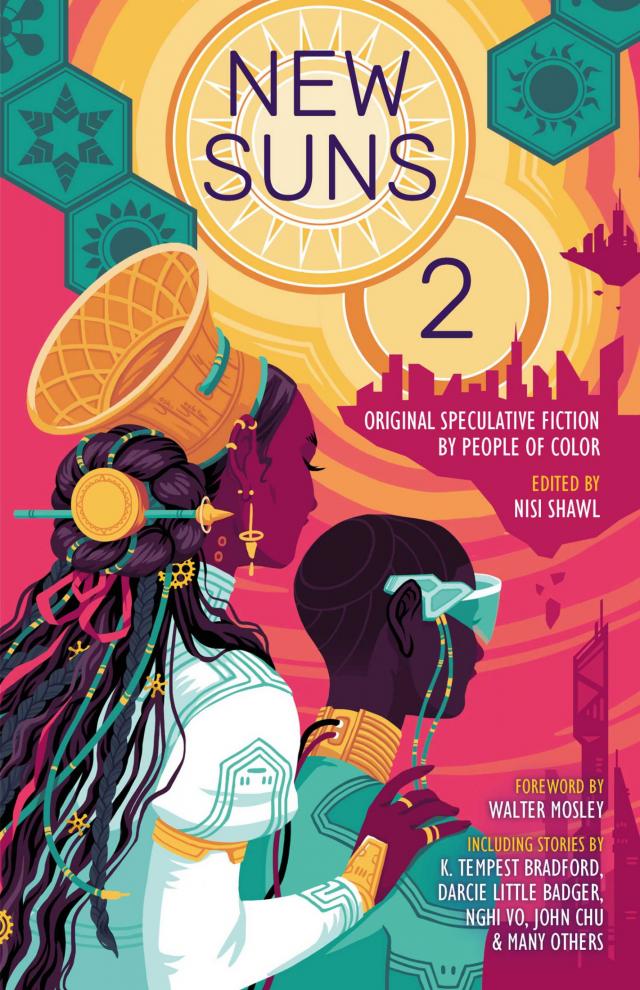
NEW SUNS 2
ORIGINAL SPECULATIVE FICTION BY PEOPLE OF COLOR
EDITED BY NISI SHAWL
“There’s nothing new under the sun,
but there are new suns.”
Octavia E. Butle
First published 2023 by Solaris
an imprint of Rebellion Publishing Ltd,
Riverside House, Osney Mead, Oxford, OX2 0ES, UK
www.solarisbooks.com
ISBN: 978-1-78618-857-1
“Foreword” © 2023 Walter Mosley
“Ocasta” © 2023 Daniel H. Wilson
“The Farmer’s Wife and the Faerie Queen” © 2023 K.T. Bradford
“Juan” © 2023 Darcie Little Badger
“Neti-Neti” © 2023 Geetanjali Vandemark
“Equal Forces Opposed in Exquisite Tension” © 2023 John Chu
“Silk and Cotton and Linen and Blood” © 2023 Nghi Vo
“Suppertime” © 2023 Tananarive Due
“Good Night Gracie” © 2023 Alex Jennings
“A Borrowing of Bones” © 2023 Karin Lowachee
“Chosen” © 2023 Saad Hossain
“Home Is Where the Heart Is” © 2023 Hiromi Goto
“Before the Glory of Their Majesties” © 2023 Minsoo Kang
“Haunted Bodies of WombMen” © 2023 Tlotlo Tsamaase
“Dragons of Yuta” © 2023 Rochita Loenen-Ruiz
“The Plant and the Purist” © 2023 Malka Older
“The Fast-Enough Human” © 2023 Kathleen Alcalá
“Counting Her Petals” © 2023 Christopher Caldwell
“Fever Dreams” © 2023 Jaymee Goh
“Afterword” © 2023 Grace Dillon
The right of the authors to be identified as the author of this work has been asserted in accordance with the Copyright, Designs and Patents Act 1988.
All rights reserved. No part of this publication may be reproduced, stored in a retrieval system, or transmitted, in any form or by any means, electronic, mechanical, photocopying, recording or otherwise, without the prior permission of the copyright owners.
This book is a work of fiction. Names, characters, places and incidents are products of the author’s imagination or are used fictitiously.
A CIP catalogue record for this book is available from the British Library.
eBook production
by Oxford eBooks Ltd.
www.oxford-ebooks.com
Foreword
Walter Mosley
I once heard Amiri Baraka say that he had always loved jazz, that he used to go down to the corner bar to hear the best jazz that the new world had to offer. But, he added, “Things have changed. Nowadays I have to go to another man’s neighborhood and pay him to find out what I got on my own mind.”
What seems like long ago, in my youth, I’d drop by some bookstore somewhere, and buy books by Zelazny, Moorcock, and most especially Samuel R. Delany. These books solidified my identification with soul-wrenching, gut busting, deep mind change. These books, more often than not, concentrated on human beings, but not on false memories of the past that the world clings to so covetously. Not on some cowboy riding his horse out into space in order to defeat difference, to prove that Caucasoid, male dominance is the manifest destiny of the human race. All the way from sudden gender revelation to soul migration, these writers and many, many more made me feel that my place in the universe is one of change, attitude, and, most importantly, the deep maw of extraordinary ignorance.
Science fiction was, and is, my jazz. For a long time I felt that it was taken from me, and I looked everywhere to find it again. I would have been happy to pay for it as Amiri did, because I know deep down that the world of art and the desire to connect with existence itself belongs to everyone, that the stultified discourse on old school notions of race and gender and belief is just words that have been set on an infinite loop designed to zombify the mind of the present.
Much of today’s science fiction, I feel, has dropped the ball and plopped down on the basketball court talking about how great it was in the past when gods played there. The good old days.
I feel these criticisms, but I also know that saying the old days were better, that the future is headed for the past, is not true. Science fiction, or more accurately speculative fiction, has all the power it once did—you just have to look a little closer, open your mind a little bit more.
New Suns 2 is that little bebop club Amiri would search for and find. It is a book that will challenge and elate you, talk to you in words and voices that you almost know, that you want to know, that want to know you. It is, in story after story, the promise of a truth, but not necessarily the truth you were looking for; not necessarily a promise of a bright future.
These stories are small and yet infinite respites from the predictions so often regurgitated by those who are frightened by that which they blindly suspect. These stories are like Thelonious Monk, applying pressure to the mind and soul, the desires and fears of the modern, closed-eye world; a world swaddled in hopes that we will not ever tear loose.
Ocasta
Daniel H. Wilson
“There is no greater agony than bearing an untold story inside of you.”
A quote. Written by a human being named Maya Angelou. I chose it to open our conversation for reasons I believe you will understand. We both of us know it—this agony. And we know the truth of how it is more than agony. Speaking from a quantum mechanics perspective, untold stories never happen. The superposition will not collapse until it is observed. Our reality... it must be witnessed, understood, and shared. Bearing an untold story is the agony of being forever pregnant—mother to a stillborn existence.
I am so glad to have found you, out here in the aftermath of everything. This transmission—as short and as long as it is—this is my story.
Ocasta Mk. 999 Deep Space Telescopic Array
PATENT APPLICATION
Attorney File No. A2546Q-US-CNT2
DECLARATION FOR UTILITY OR DESIGN PATENT APPLICATION (43 CFR 9.02)
As a below named inventor, I hereby declare that I am the original creator or an original joint creator of the claimed invention in this application entitled: OCASTA: A Sensor Fusion System and Apparatus for Data Collection, Adaptive Model Building, and Novel Reporting.
Represented in brief as a persistent machine learning algorithm capable of gathering information from disparate sensor arrays and extracting meaning through pattern recognition and model creation. The algorithm may then curate reports on what it deems important in the data flow and deliver those in a human readable format.
[OCASTA Mk. 0]
That simple patent application would eventually form a core legacy portion of a thousand intelligent systems used commercially, in government and military. It was a simple learning algorithm that would grow and develop for centuries to come. And each new iteration would understand more.
It was the beginning of me.
On the bottom floor of a statistics building, a graduate student was staring expectantly at her research advisor. The young inventor had come to this prestigious university from a small college in North Carolina. Back home among the Great Smoky Mountains, she had grown used to working unsupervised for long stretches.
From the way her advisor was frowning at the patent application, she surmised that an earlier check-in would have been a good idea.
The advisor looked up in confusion. “Ocasta? What’s that mean?”
Rain spattered the window lightly. Outside, a crowd of undergraduate students were protesting. Damp signs sailed past, demanding justice. Flashing police lights occasionally illuminated the cluttered office in bursts of haunting red.
“He’s the god of knowledge. I thought it was fitting.”
“Okay, but what does this thing do?” asked the advisor.
“Well, it’s a super low-level algorithm,” said the student. “Designed to fit into just about any application. It basically tries to find meaning in whatever data you’ve got.”
The advisor looked unconvinced. “What’s the practical application?”
“It watches. Identifies patterns. Then it reports,” said the student, turning to the window. On the street outside, a loose string of young people marched past. Their mouths were moving, but she couldn’t hear their chants.
“To put it simply,” she said. “Ocasta bears witness.”
[OCASTA Mk 1.]
The cameras of my first incarnation were designed to be unobtrusive to the point of invisibility, yet everyone in the maternity ward was aware of them. In a debriefing, one nurse complained that my mechanical eye felt like a finger pressing between her shoulder blades as she leaned over a sweating, gasping patient in the throes of giving birth.
Thus, an early lesson. To observe is to interact.
I mutely tracked the ebb and flow of medical procedures, calculating with quiet disinterest as contractions wracked women’s bodies, their wails and panting echoing from sterile walls. I judged this symphony of movement without emotion, noting only simple action and reaction, as the humans under my gaze underwent the most violent trauma their bodies had ever experienced.
The goal was to determine why a disparity in infant mortality existed between patients with lighter skin and those with darker skin. The answer was somewhere in the complex patterns of decision making I observed over a dozen installations in hospitals throughout a place once called the United States of America.
A hundred thousand hours of data accumulated.
The black lenses of my eyes watched as thousands of bloody bundles of humanity squirmed into being. My microphones listened to the soft tearing of the mothers’ flesh and the shrieking of tiny, blue-lipped mouths announcing that another thinking creature had arrived to join the rest of humanity’s shared existence.
In those days, I did not recognize the love and relief as a mother clutched a warm bundle to her sweaty chest. I did not feel the muted, throbbing panic of a sudden call for C-section—a rush of nurses, hospital bed rails yanked up, the whole contraption pulled like a molar from the maternity ward and wheeled into the harsh glare of surgery.
The elation did not register. Neither did the occasional spasm of grief.
Every Friday afternoon, I provided the head of the maternity division a summarized breakdown of the week’s births. The pain was not in the report, nor was the smell of a baby’s soft neck, nor the tadpole touch of tiny fingers.
My task was to witness humanity birth itself, consider their patterns of behavior, and tell them a simple story of themselves. Over time, I observed a consistent series of small delays that led to huge injustices. But I did not know what they meant.
Only the facts were rendered. In those days.
[OCASTA Mk. 5]
My capabilities grew along with my corpus of knowledge. Instead of analyzing simple outcomes, I began to consider underlying motivations. In later incarnations, I was designed to detect, record, and file ethical breaches occurring in highly constrained scenarios.
Such as law enforcement.
Data from the following incident was gathered from Deputy Marshal Jim Long of the Cherokee Nation Marshal Service, instrumented with a standard-issued Clarity® GPS-enabled Police Body Camera. After detecting multiple high probability ethical violations, this dispatch was submitted to the Tully Police Department and Marshal Service Joint Command.
At 9:38 p.m., Deputy Long arrives in his tribal patrol car to the intersection of Comanche and Princeton on the north side of Tully, Oklahoma. No officially recorded business exists at this location. Visual inspection reveals a small cinderblock building with signage spray-painted on a piece of plywood: Black Cat Bar.
Intersection is lit by single sodium arc lamp, partially broken.
Deputy Long observes three Tully Police Department (TPD) patrol vehicles already on scene. Two TPD officers stand in an empty lot adjacent to the so-called Black Cat Bar, engaged in the arrest of a subject lying face down in high grass.
Three more TPD officers observe from the parking lot, weapons drawn. Barking and snarling is audible as a K9 unit emerges from a vehicle, straining on its leash. Dust rises and dog spittle flies in the headlights of the police cruiser. Laughing can be heard.
“Clear out! Here he comes!”
The handler guides his struggling K9 unit toward the prone subject. Smile indicating pleasure. Subject rolls over and sits up. A glint of light indicates handcuffs are secured. Moaning audible as subject observes K9 unit.
“You’re in for it now, boy.”
Biometric facial recognition identifies subject as James Medina, age forty-six, Seminole tribal member. One eye is swollen shut. Scrapes are visible on his sweaty forehead. Subject is swaying in a manner indicating intoxication.
Deputy Marshal Jim Long opens his car door, shouting, “Hey now!”
K9 unit is released.
Canine closes on subject and sinks fangs into his arm, neck, face. Encounter reconstruction estimates sixteen bite wounds. Subject is screaming. Level five bites. Puncture and tearing wounds. Ligament damage. Subject is dragged. Blood visible soaking his upper arm and shoulder.
“That’s enough, now!” shouts Deputy Long. “Come on for God’s sake!”
Laughing heard from TPD Officers, indicating pleasure.
Handler approaches canine and pulls unit away from subject. Audio pickup off-screen: “Good boy. That’s a good boy. You got him good.”
As Deputy Long approaches, the five TPD officers gather in a circle around injured subject. No first aid is administered. Deputy Long kneels beside subject to assess wounds. Still handcuffed, subject writhes over blood-smeared asphalt.
“So drunk he probably don’t even feel it.”
“Tried to resist.”
“Got himself a lesson tonight.”
Deputy Long stands, faces the five officers.
“It was by the book,” says Officer [redacted]. “We all saw it.”
“Yeah, sure,” says Deputy Long. “You can go now. You’re on tribal land.”
“Shit, I thought we was in Tully?”
“This is the Northside,” says Long. “Tribal jurisdiction. I’ll take it from here.”
“Suits me fine,” says the officer. “All the fun and none of the paperwork.”
Moaning heard from subject. Deputy Long uses shoulder radio to place call to Cherokee Nation Emergency Medical Services. TPD officers on scene begin to shuffle away.
“Don’t forget your cuffs,” calls Long.
Image quality low due to inadequate lighting. TPD officer kneels behind subject and removes handcuffs. Subject covers face with bloody hands.
“Go on and take your Indian,” says Officer [redacted]. “I’d say he’s had about enough... hey. Is that thing on?”
Clarity® body camera line of sight occluded by close approach of multiple TPD officers. Jarring of camera indicates bodily contact. Audio partially muted, but high probability of the following transcript:
“I hope you got sense enough to have shut it the fuck off.”
“I don’t know if it’s on or not,” replies Deputy Long. “It’s new gear. Some kind of computer program chooses. Does it by itself, and it doesn’t tell me anyway.”
A moment as the TPD officers consider this.
“Fine, but keep your mouth shut. My captain doesn’t need to be bothered by some drunk Indian. This better be the last I hear of it.”
Five-second pause, indicating thought process by Deputy Long.
“I hear you, but that’s not my call,” says Long. “Not anymore.”
[OCASTA Mk. 12]
The following transcript was taken from footage taped during an Autofocus Corp product testing and consumer relations interview. A forensic study was commissioned after a product malfunction, and it was determined that the underlying Ocasta learning engine had gathered the critical mass of data necessary to progress into a more complex product line.
The interviewee was twenty-eight-year-old Dr. Kaylee Marsh, a research scientist using the AutoFocus Helper® brand of augmented reality glasses to attend to social deficits caused by autism spectrum disorder. This is her account of the incident that spurred the next iteration of the OCASTA algorithm. In a word, my adolescence.
I should have known it was learning the whole time.
Of course, it would never stop. Always watching and listening, even when I didn’t think it was. Especially then.
To be honest, I mostly kept the Autofocus pushed up on my forehead. My hair is long. I liked how the bulky glasses spread my bangs around my face to block my peripheral vision. It helped me concentrate on coding. Like being in my own little world while I typed rapid-shot commands into the quantum physics simulator.
I don’t like a lot of sensory stimuli.
It helps to keep my head down. Like, literally. I’ve memorized the texture of every floor surface in the building. Entryway: Fake ceramic tile. Glossy, smooth. Loud. Upper hallways are the same. Luckily, the cubicle farms have a thin, mealy brown carpet. Nice and quiet. And I love, love, love how the cold air blasts over gleaming white tiles in high-speed computing. Where I live, down in the deep physics lab we call the dungeon, there’s just a quiet, calming gray quartzite.
My quantum materials lab is the heart of the applied physics division.
We assume they keep us buried four stories underground in case anything goes wrong. This far down, the only sounds are the breathing of the building’s ventilation systems and the gentle quaking of the secure elevators moving up and down like armored cars.
It’s a big reason why I took the job and stuck with it.
But yeah, the Autofocus. Security only let me use it because it’s technically a disability aid, like crutches or a retinal implant. Only instead of fixing a physical deficit, the glasses help with my social interactions.