

Continuum 1, p.1
Continuum 1, page 1
part #1 of Continuum Series


Wide-Spread Praise For
Continuum 1:
“A Truly New Type of Anthology… a long time coming and quite unexpected, this title is a real treat to every science fiction fan.”
The News American — Baltimore
“The writers are top-flight… Please rush Continuum 2, Mr. Publisher. Can’t wait to see what happens!”
Fresno Bee — Fresno, California
“CONTINUUM 1 employs a truly new idea in editing… fit is an excellent idea and I find the first volume highly successful and promising.”
News-Sentinel — Fort Wayne, Indiana
“Here are some of the most solid names in current science fiction.”
Herald American
— Palm Springs, California
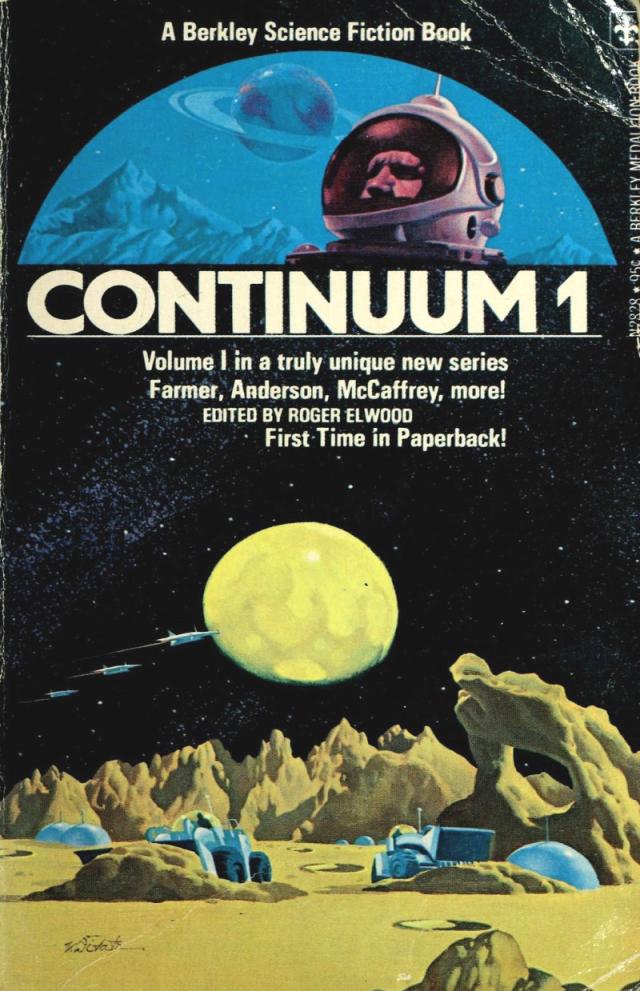
Continuum 1
* * *
Edited by
Roger Elwood
Copyright © 1974, by Roger Elwood
All rights reserved
Published by arrangement with G. P. Putnam’s Sons
All rights reserved which includes the right to reproduce this book or portions thereof in any form whatsoever. For information address
G. P. Putnam’s Sons
200 Madison Avenue
New York, New York 10016
Library of Congress Catalog Card Number: 73-87184
SBN 425-02828-3
BERKLEY MEDALLION BOOKS are published by
Berkley Publishing Corporation
200 Madison Avenue
New York, N. Y. 10016
BERKLEY MEDALLION BOOKS * TM 757,375
Printed in the United States of America
Berkley Medallion Edition, MAY, 1975
Continuum 1
Introduction
Roger Elwood
Stations of the Nightmare — Part One
Philip José Farmer
My Own, My Native Land
Poul Anderson
Shaka!
Chad Oliver
The Armageddon Tapes — Tape I
Thomas N. Scortia
Prelude to a Crystal Song
Anne McCaffrey
The Dark of the June
Gene Wolfe
The Children’s Crusade
Edgar Pangborn
The Night of the Storm
Dean R. Koontz
Introduction
There are several excellent anthology series available today: Damon Knight edits one, Bob Silverberg has another, and so does Terry Carr. Each is based upon a single premise, fashioned by the editor’s individual tastes: namely, the best science fiction written in an atmosphere of creative freedom.
But — and it’s not a shortcoming, just a fact — there is no other connection between, say, New Dimensions 1 and New Dimensions 2; or Universe 1 and Universe 2. All present solid, top-notch science fiction by well-known and beginning authors… period. Considering the quality of these books, that’s a strong raison d’etre.
But the Continuum anthologies are, frankly, based upon an additional premise: a tightly woven series of threads will ultimately tie all four books closely together.
What does this premise mean?
That each story in each anthology is part of a series written by the author in question. There are eight stories in Continuum 1; eight in Continuum 2; and so on. That means, also, eight series. Thus, with all four books, there will be a total of thirty-two episodes — four episodes per series.
Now, each story is, in theory and actuality, a separate entity. We’re not fostering Flash Gordon cliff-hangers here. You don’t have to buy the second book to enjoy the first; and vice versa.
Yet, with the four Continuum anthologies, the series format reaches its full potential, with each series a minimum of 25,000 words all told; there is only one exception: Gene Wolfe’s delightful short-shorts.
Since each story was written by the author as a separate entity, able to stand on its own, there was no sacrifice of artistic quality; no subsequent story was written simply to fulfil the series format. Thus, in several instances, authors discarded initial creations because after one or two stories, to add the remaining number would have meant sheer padding, and by the time the fourth story was written, well, it would have been just an assembly-line job. Only stories that naturally fit the series guidelines, and are valid separately, have been accepted for Continuum.
It is awkward for an editor to praise stories in books that he puts together because these comments usually seem self-serving. I run that risk here but to be able to note how much I think of these stories, well, it’s worth the risk, in my opinion.
I doubt very much that any of the authors herein have done material that is significantly better than that which is represented in this Continuum or in the others comprising this series. A number are breathtaking tours de force which I have re-read several times since accepting them for publication.
I would very much like to extend thanks to George Ernsberger, Editor-in-Chief of Berkley Books, for his patience and his help in a variety of ways. George is one of those rare editors who possess boundless degrees of creative insight yet who permit their authors/anthologists to express themselves in the best way possible. Deep thanks also to Virginia Kidd, someone else whose relationship I value highly and who has been both a friend and a strong impetus in the aim to settle for nothing less than the very best.
Continuum is a new concept in anthologies. We sincerely hope that, as far as you, the reader, are concerned, it is also a satisfying one.
Roger Elwood
Margate, N.J.
Philip José Farmer
Stations of the Nightmare
Part 1: The Two-Edged Gift
1.
Paul Eyre shot a flying saucer.
On this bright morning, he was walking through a farmer’s field. Ahead of him was the edge of a wood bisected by a small creek. Riley, the setter, had just stiffened. Nose down, crouched low, seeming to vibrate, he pointed toward the magnet, the invisible quail. Paul Eyre’s heart pumped a little faster. Ahead of Riley, a few yards away, was a bush. Behind it should be the covey.
They broke loose with that racket that had made him jump so when he was a novice. It was as if the earth had given violent birth to several tiny planets. But there was not the dozen or so he had expected. Only two. The lead one was much larger than the other, so much larger that he did jump then. He knew as the shotgun roared and kicked that it was not a bird.
The concentrated pattern of his modified choke must have hit the thing squarely. It fell away at a forty-five degree angle instead of dropping as a dead bird drops, and it crashed through the lower branches of a tree on the outskirts of the wood.
Automatically, he had fired the second barrel at the trailing bird. And he had missed it.
The thing had rocketed up like a quail. But it had been dark and about two feet long. Or two feet wide. His finger had squeezed on the trigger even as his mind had squeezed on the revelation that it was not a winged creature.
It wasn’t a creature, he thought, but a made thing. More like a huge clay pigeon than anything else.
He looked around. Riley was a white and black streak, running as if a cougar were after him. He made no noise. He seemed to be conserving his breath as if he knew he’d need every atom of oxygen he could get. Behind him was a trail of excrement. Ahead of him, over half a mile up the slope, was a white farmhouse and two dark-red barns.
Roger, Paul’s son, had spoken of mines which flew up into the air before exploding. This thing had not been attached to a chain nor had it blown up. It could be a dud. But there had been no blast as it soared up. Perhaps the noise of his shotgun had covered it.
He shook his head. It could not have been anything like that. Unless… Had some vicious person put it in the field just to kill hunters? Senseless violence was on the increase in this God-forsaking country.
The situation was much like that of a car that refused to run. You could think about it all you wanted to and make mental images of what was wrong. But until you opened the hood and looked at the engine, you would not be able to make a definite analysis. So he would open the hood.
He walked forward. The only sound was the northwest wind, gentle here because the woods broke it. The bluejay and the crows that had been so noisy before he had fired were quiet. There was the bluejay, sitting on a tree branch. It seemed frozen with shock.
He was cautious but not afraid, he told himself. He had been afraid only three times in his life. When his father had deserted him, when his mother had died, and when Mavice had said she was leaving him. And these three events had taught him that nothing was as bad as he’d thought it at the time and that it was stupid, illogical to fear. He and his brothers and sisters and mother had gotten along without his father. His mother’s death had actually made his life easier. And Mavice had not left him.
“Only the unimaginative, of whom you are the king, have no fear,” Tincrowdor had told him. But what did that effete egghead know of real life or real men?
Nevertheless, he hesitated. He could just walk away, round up the dog, and hunt elsewhere. Or, better, tell Smith that someone had planted a strange mechanical device in his field.
Perhaps, though he did not like to admit it, his sight had betrayed him. Behind his glasses were fifty-four-year-old eyes. He was in good shape, better than most men twenty years younger. Much better than that Tincrowdor, who sat on his tocus all day while he typed away on his crazy stories.
Still, he had been informed by the optometrist that he needed a new prescription. He had not told anyone abou t this. He hated to admit to anyone that he had a weakness, and that anyone included himself. When he had a chance to get fitted with new lenses, with no one except the doctor the wiser, he’d go. Perhaps he should not have put it off so long.
He resumed walking slowly across the field. Once, he looked toward the farmhouse. Riley, his pace undiminished, was still headed toward it. When he caught Riley, he’d rap him a few on the nose and shame him. If he were ruined by this, he’d get rid of him. He couldn’t see feeding something that was useless. The hound ate more than he was worth as it was.
He could imagine what Mavice would say about that. “You’re going to retire in eleven years. Would you want us to give you away or send you to the gas chamber because you’re useless?”
And he’d say, “But I won’t be. I’ll be working as hard as ever on my own business after I’ve retired.”
He was ten feet from the wood when the yellow haze drifted out from it.
2.
He stopped. It couldn’t be pollen at this time of the year. And no pollen ever glowed.
Moreover, it was coming with too much force to be driven by the wind. For the second time, he hesitated. The thick yellow luminance looked so much like gas. He thought about the sheep that had been killed in Nevada or Utah when the army nerve gas had escaped. Could — But no… that was ridiculous.
The shimmering haze spread out, and he was in it. For a few seconds, he held his breath. Then he released it and laughed. The stuff blew away from his face and closed in again. Here and there, some bits sparkled. Before he reached the trees, he saw tiny blobs form on the grass, on his hands, and on the gun barrels. They looked like gold-colored mercury. When he ran his hand over the barrels, the stuff accumulated at the ends into two large drops. They ran like mercury into the cup formed by his palm.
Its odor made him wrinkle his nose and snap it to the ground. It smelled like spermatic fluid.
It was then that he noticed that he had not reloaded. He was mildly shocked. He had never missed reloading immediately after firing. In fact, he did it so automatically that he never even thought about it. He was more upset than he had realized.
Abruptly, the haze or fog, or whatever it was, disappeared. He looked around. The grass for about twenty feet behind him was faintly yellow.
He went on. A branch, broken off by the thing, lay before him. Ahead was the dense and silent wood. He pushed through the tangles of thorn bushes, from which he had flushed out so many rabbits. And there was one now, a big buck behind the thorns. It saw him, saw that it was seen, but it did not move. He crouched down to look at it. Its black eyes looked glazed, and its brown fur scintillated here and there with yellowness. It was in the shade, so the sun could not be responsible for the glints.
He poked at it, but it did not move. And now he could see that it was trembling violently.
A few minutes later, he was at the place where the thing would have landed if it had continued its angle of descent. The bushes were undisturbed; the grass unbent.
An hour passed. He had thoroughly covered the woods on this side of the creek and found nothing. He waded through the waters, which were nowhere deeper than two feet, and started his search through the woods on that side. He saw no yellow mercury, which meant one of two things. Either the thing had not come here or else it had quit expelling the stuff. That is, if the stuff had been expelled from it. It might just be a coincidence that the stuff had appeared at the same time the thing had disappeared. A coincidence, however, did not seem likely.
Then he saw a single drop of the mercury, and he knew that it was still… bleeding? He shook his head. Why would he think of that word? Only living creatures could be wounded. He had damaged it.
He whirled. Something had splashed behind him. Through a small break in the vegetation, he could see something round, flat, and black shooting from the middle of the creek. He had seen it before at a distance and had thought it was the top of a slightly rounded boulder just covered by the creek. His eyes were going bad.
He recrossed the creek and followed a trail of water which dwindled away suddenly. He looked up, and something — it — dropped down behind a bush. There was a crashing noise, then silence.
So it was alive. No machine moved like that, unless…
What would Tincrowdor say if he told him that he had seen a flying saucer?
Common sense told him to say nothing to anybody about this. He’d be laughed at, and people would think he was going insane. Or suffering from premature senility, like his father.
The thought seemed to drive him crazy for a minute. Shouting, he plunged through the bushes and the thorn tangles. When he was under the tree from which the thing had dropped, he stopped. His heart was hammering, and he was sweating. There was no impression in the soft moisture-laden ground; nothing indicated that a large heavy object had fallen onto it.
Something moved to the right at the corner of his eye. He turned and shot once, then again. Pieces of bushes flew up, and hits of bark showered. He reloaded — he wasn’t about to forget this time — and moved slowly toward the base of the bush at which the thing seemed to have been. But it wasn’t there anymore, if it had ever been there.
A few feet further, he suddenly got dizzy. He leaned against a tree. His blood was thrumming in his ears, and the trees and bushes were melting. Perhaps the yellow stuff was some kind of nerve gas.
He decided to get out of the woods. It wasn’t fear but logic that had made him change his mind. And no one had seen him retreat.
Near the edge of the woods, he stopped. He no longer felt dizzy, and the world had regained its hardness. It was true that only he would know he had quit, but he wouldn’t ever again be able to think of himself as a real man. No, by God — and he told himself he wasn’t swearing when he said that — he would see this out.
He turned and saw through the screen of bushes something white move out from behind a tree. It looked like the back of a woman’s torso. She wore nothing; he could see the soft white skin and the indentation of the spine. The hips were not visible. Then the back of the head, black hair down to the white shoulders, appeared.
He shouted at the woman, but she paid no attention. When he got to the tree where she had first appeared, he could no longer see her. Some of the grass was still rising, and some leaves had been distorted.
An hour later, Paul Eyre gave up. Had he just thought he’d seen a woman? What would a woman be doing naked in these woods? She couldn’t have been with a lover, because she and the man would have gotten out of the woods the first time he’d fired his shotgun.
On the way back, he thought he saw something big and tawny at a distance. He crouched down and opened the bush in front of him. About thirty yards off, going behind an almost solid tangle, was the back of an animal. It was yellowish brown and had a long tufted tail. And if he hadn’t known it was impossible, he would have said that it was the rear end of an African lion. No, a lioness.
A moment later, he saw the head of the woman.
She was where the lion would be if it stood up on its hind legs and presented its head.
The woman was in profile, and she was the most beautiful he had ever seen.
He must be suffering from some insidious form of Asiatic flu. That would explain everything. In fact, it was the only explanation.
He was sure of it when he got to the edge of the trees. The field was covered with red flowers and at the other side, which seemed to be miles away, was a glittering green city.
The vision lasted only three or four seconds. The flowers and the city disappeared, and the field, as if it were a rubber band, snapped back to its real dimensions.
He could hear it snap.






