What the body remembers, p.1
What the Body Remembers, page 1
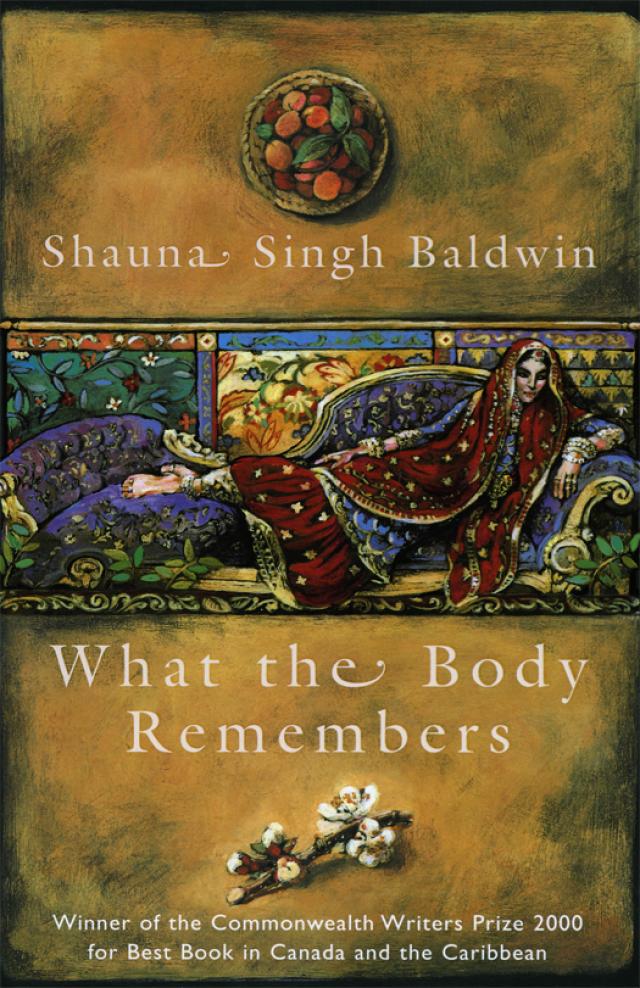


What the Body Remembers
Winner of the Commonwealth Writers Prize 2000 for Best Book in Canada and the Caribbean
“Intensely atmospheric.… A stunning first novel that entwines the fate of three remarkable characters.… Baldwin achieves an artistic triumph on two levels, capturing the churning political and religious history of modern India and Pakistan as she explores memorable transformations: of Satya … of Sardarji … and finally of Roop.”
Publishers Weekly (starred review)
“Baldwin’s protagonists will keep a reader captivated throughout the long journey of the novel.… [Her] gift of creating convincing interior dialogue is ever-present.… What the Body Remembers will leave its readers full, certainly, and like all fine works, the digestion will take many days, and the feast remembered the more fondly for it.”
New Brunswick Telegraph-Journal
“Wonderful! Wonderful! I just finished What the Body Remembers—what an amazing novel! I feel it has expanded my understanding of the world vastly. And as a writer, I feel nourished, replenished. I drink your words!”
Sandra Gulland, author of Tales of Passion, Tales of Woe
“An impressive debut.”
National Post
“An impressive achievement … rich, fascinating, epic.… [Baldwin] weaves a richly textured tapestry of a complex and cruel society built around the second-classness of women.… An original, extremely readable book that dramatizes the plight of Indian women with great sympathy and love.”
The Gazette (Montreal)
“Astonishing.… The individual stories and complex religious and philosophical divisions are woven into the larger picture with supreme confidence and a poetic intensity. The characters shimmer with life, their predicaments grab the reader by the throat, their fate has the reader on the edge of the seat, their individual psychological journeys are instantly recognizable.”
The Times (London)
VINTAGE CANADA EDITION, 2000
Copyright © 1999 by Vichar
Vichar is a division of Shauna Baldwin Associates, Inc.
All rights reserved under International and Pan-American Copyright Conventions. Published in Canada by Vintage Canada, a division of Random House of Canada Limited, in 2000. First published in hardcover in Canada by Alfred A. Knopf Canada, Toronto, in 1999. Distributed by Random House of Canada Limited, Toronto.
This is a work of fiction. The characters in it are all fiction. Resemblance to any persons living or dead is purely coincidental. Liberties have been taken with a few building locations in Lahore, the name of the village of Pari Darveza, a garden mentioned in Rawalpindi and the description of the canal colony in Khanewal.
Vintage Canada and colophon are registered trademarks of Random House of Canada Limited.
Canadian Cataloguing in Publication Data
Baldwin, Shauna Singh, 1962–What the body remembers
ISBN 0-676-97318-3
eBook ISBN: 978-0-345-81090-8
I. Title.
PS8553.A4493W42 2000 C813’.54 C00-931378-8
PR9199.3.B34W42 2000
Visit Random House of Canada Limited’s Web site: www.randomhouse.ca
v3.1
For Amir,
Alexander Arjan,
Sheila-Anne Jaya,
Piya, Ria and Toya,
Anyshka and Pravir,
and Ameera
Contents
Cover
Title Page
Copyright
Dedication
Map
Prologue
One: 1937
Chapter 1
Two: 1928–1937
Chapter 2
Chapter 3
Chapter 4
Chapter 5
Chapter 6
Chapter 7
Chapter 8
Three: 1937–1940
Chapter 9
Chapter 10
Chapter 11
Chapter 12
Chapter 13
Chapter 14
Chapter 15
Chapter 16
Chapter 17
Chapter 18
Chapter 19
Chapter 20
Chapter 21
Chapter 22
Chapter 23
Four: 1940–1941
Chapter 24
Chapter 25
Chapter 26
Chapter 27
Five: 1942
Chapter 28
Chapter 29
Chapter 30
Six: 1943–1944
Chapter 31
Chapter 32
Chapter 33
Seven: 1945–1946
Chapter 34
Chapter 35
Eight: 1947
Chapter 36
Chapter 37
Chapter 38
Chapter 39
Chapter 40
Chapter 41
Epilogue
Acknowledgments
About the Author
Prologue
UNDIVIDED INDIA, 1895
I have grey eyes in this lifetime and they are wide open as I am severed from my mother’s womb. The futility of tears is for those who have not, as I have, rolled the dice a few times.
If the circle that is your body falls on a ladder inscribed on the game board of time, you climb. If it lands on a snake, you slip-slide back. Resume your journey again.
And if you do not learn what you were meant to learn from your past lives, you are condemned to repeat them.
This is karma.
So I do not cry, but I shriek and I curse and I rail as the midwife wraps me.
The midwife knows as I do already, testing the kick in my legs, that I am not a boy. Against all odds, against every pandit’s promise, despite a whole life of worship and expiation, I have slid down the snake’s tail and for all the money and temple offerings I lavished on pandits the last time round, here I am again … born a woman.
All I have in the life I live now is my kismat: my wits and my will conjoined with my stars.
So angry am I, my eyes are open wide—never open your eyes in a new life without forgetting your past ones. The midwife rolls me this way and that; she hopes it will soothe me. A girl who comes into this world with her eyes wide open will never lower them before a man.
If I find any of those pandits, I’ll tear their hearts out.
Send their djinns to become insects again.
One
1937
CHAPTER 1
Rawalpindi, Undivided India, 1937
SATYA’S HEART is black and dense as a stone within her. She tells herself she pities Roop, but hears laughter answering her—how difficult it is to deceive yourself when you have known yourself a full forty-two years.
She has a servant summon Roop to her sitting room in the afternoon, when Sardarji has gone to a canal engineers’ meeting. When she comes before her, Satya does not speak, but rises from the divan and takes Roop’s chunni from her shoulders, as if in welcome, so she can study the girl. She takes Roop’s chin and raises her face to the afternoon sun, willing it to blind her, but it will do her no such service. She studies Roop’s features, her Pothwari skin, smooth as a new apricot beckoning from the limb of a tall tree, her wide, heavily lashed brown eyes. Unlike Satya’s grey ones, they are demurely lowered, innocent.
A man could tell those eyes anything and they would believe him, a man could kiss those red lips for hours and they would look fuller and more luscious for the bruising.
Roop’s hair is long, to her thighs, softened by amla and scented with coconut. Unlike Satya’s, it has no need yet for henna. Satya lifts Roop’s plait around her shoulder and examines the tip—too few split ends; it has felt the scissors once at least, if not more.
Roop is a new Sikh, then, an uncomprehending carrier of the orthodoxy resurging in them all. Hindus, Sikhs, Muslims, they are like the three strands of her hair, a strong rope against the British, but separate nevertheless.
She unbinds Roop’s hair. It falls, a moonlit river, down the valley of her spine.
She examines Roop’s teeth and finds all of them whole, the back ones barely visible. She hopes that as they come they will bring pain. Roop’s tongue is soft and a healthy pink and from it a man will hear no truths he cannot explain away. She presses her fingers to Roop’s cheekbones, they are high, like her own. Some remnant of Afghan blood in their past; in other circumstances she might have been Roop’s aunt or cousin.
Satya’s hands drop to Roop’s neck and encircle it lightly, for she is not trying to frighten her. And she sees Sardarji has given her a kantha necklace, one of her own. She knows the gold of this one well; she ordered it from the goldsmith herself, she knows every link in it and the sheen of its red enamel. She wore it last to a party full of Europeans. Its brilliance and its weight had comforted her, compensation for her tongue-tied state; the European ladies ignored her once they found she spoke no English.
She sees her kantha now, covering the hollow at Roop’s neck and she wants to press her thumbnail in that hollow till Roop’s red blood spurts and drips over them both.
She wants this.
She moves her hands, with no sign she recognizes the kantha, no hint she knows that Roop standing before her is a silent thief.
With such a tremulous placating smile.
Satya examines Roop’s brow. Time is ploughing her own in three horizontal furrows, deepening by the day, but Roop’s is still smooth. She pulls Roop’s hair back over her ears and
And Roop is wearing them.
Satya wants to tear them from the girl’s ears, watch as Roop’s tender lobes elongate and rip apart, wants to take back what is hers, rightfully hers.
But she moves her hands away.
“Come lie with me in the afternoons. You are alone on your side of the house, I am alone on my side. My pukkhawalla is better—he’s from my village, our men are strong.”
Roop stands, uncomprehending. If she had been a blood-niece, or a cousin-sister, Satya would shout at her to stay away, to turn now and run before she gets hurt. And if Satya had been Roop’s mother, Roop would be her daughter and none of this would have been necessary.
“Come,” she says again. “It is useless for me to fight Sardarji’s will; he is my husband, he has married you. Somehow I must accept that—and you.”
Roop’s face lights up like a diya at Diwali.
“Oh, Bhainji.”
Sister.
Satya does not feel sisterly at all.
“Oh, Bhainji,” Roop says. “I’m so glad. I told Sardarji, I will be no trouble, I will be just like a younger sister.”
And her silly tears fall on Satya’s hand as she leads the girl to the bed.
Satya places herself in the path of the light from the inner courtyard, dismissing the servants hovering in attendance on the gallery that runs past her rooms. She lowers the reed chics past the casement till the sitting room, cool and dark, holds the sun at bay. The jute sack covering the block of ice in the corner slips to the floor. Exposed, the ice absorbs afternoon heat, weeps a dark puddle over the polished wood.
On the gallery, a pukkhawalla spits a red stream of paan, squats, his back to the wall. With a rope over one shoulder, he leans into pulling rhythm.
Back and forth, back and forth.
The rope worms through the wall and over a pulley near the ceiling, sets the huge wing of silk above the two women creaking.
Back and forth, back and forth.
The breeze from the pukkha moves from Satya to Roop and back again, doing nothing to cool Satya. She is white-hot inside, though if she could speak it out loud, it would be better to call it hurt or pain.
“Come, lie down,” Satya says.
She leads Roop from the sitting room to her bedroom and places a soft pillow beneath Roop’s head to cradle her ruby earrings. She hears Roop’s jutis plop to the floor behind her as the young girl draws her feet up, kundalini-snake on Satya’s bed. She leans over Roop the way Sardarji leaned over Satya the years she cried for children, brushing tears from Roop’s heavy lashes with her lips. She strokes her head as a mother would, says, “Sleep, little one, we are together now.”
And Roop sleeps, overcome by the afternoon heat.
While Satya watches her.
So trusting, so very stupid.
On Roop’s arm, thrown back over her head, are Satya’s gold bangles, and on her fingers, Satya’s rings. Her feet are small and narrow for her height. Around her ankles she wears Satya’s gold panjebs. On her toes, Satya’s toe rings.
Satya could unfasten them from Roop while she sleeps, but thievery has never been a trait in her family.
Why is Roop so trusting? How can she be so confident she will produce a child? How can Roop not look at her, Satya, and think, “This is what I might become?” How can she not see danger in blundering deep into the tigress’s den to steal her chance of ever bearing a cub?
Had Satya been like her once? Had she ever been so witless and yet so charming?
Young women these days think they are invincible, that they have only to smile and good things will happen to them.
Look at me, she wants to tell her. Barren, but still useful; she manages Sardarji’s whole estate. Does Roop think it an easy task? Does Roop think it means just giving orders?
“No, little ‘sister,’ ” she will say, “Sardarji’s mukhtiar, Manager Abdul Aziz, does my bidding because he respects my judgment, he knows he cannot cheat me, I am too watchful. Not a pai of Sardarji’s money is spent on mere ornamentation or given to the undeserving.”
The money she gave to the sants, though … that was a contribution to their future.
Perhaps Sardarji felt she gave the holy men too much—then he had only to say one word! One word in her ear and she would not have spent another pai on intercessors, but would have prayed to Vaheguru herself.
Only, she has never felt that Vaheguru listens to a woman’s prayers.
When Sardarji’s sister, Toshi—that churail! that witch!—when she began her insinuations that Sardarji should marry again, Satya laughed. Said, “Yes, what a good idea!”
And she said she would find a good Sikh girl herself, a woman for her husband.
She said this for ten years while her heart sank lower and lower and her body betrayed her every moon-month with its bleeding. And in that time, the man who could best protect her, her father, lost his power. Thin, maudlin, lazy—that is not a man. When the British turned land rights to paper, he could prove nothing, not even fitness for working! He lost the land. Never even knew it until he tried renewing his land pledges for more liquor, more opium, then more liquor. By then it was too late. In the end he locked himself in a room with all the British-supplied gin he could muster and drank himself to death—one gulp, one drink, next drink, next gulp.
When he was gone, Satya’s only brother sold the last of the land to buy a lorry and sent their mother, practical, accepting old Bebeji, to live with a cousin. He lived in that lorry only three days before a band of dacoits drove him from it and left his robbed, bleeding corpse half hidden in a wheat field by the roadside. A Sikh tenant-farmer’s wheat field, not even some high-up landowner’s wheat field! What a way to die: young, and for no reason. Not even a martyr’s death, or a soldier’s. Just a useless, meaningless death.
Satya will not die that way.
No, when she dies there will be a reason.
With her brother’s death, her doom wrote itself into the lines of her hands. The palmists said they saw a daughter or a long-lost sister in her hand. They said it in the “could-be” tone of men who trade the kindness of lies for the wisdom of truth; they have to make a living.
Still Satya found no woman ugly enough for Sardarji to marry.
In all the Sind-Sagar doab, that land that lies between the Indus and its sister river, the Jhelum, where women are raised to bend like saplings with every wind so long as it speaks with a voice of authority, Satya found no woman pliant enough for her husband. Though she was far from schooled, she found no woman schooled enough to match him. Though she could speak no English, she declared his new mate must know the git-mit, git-mit talk and be raised to sit on chairs. And as the times changed and women began to walk in the streets and even in protest marches, she declared all of them unworthy to come into her presence, let alone his.
When she was forty years old, she read her fate in Toshi’s eyes, saw it in the way she and her husband, Sardar Kushal Singh, ignored her when they came to visit, and no longer asked about her when Sardarji stopped to visit at their home. She went to the sants then and asked them for curses. They told her they were men devoted to God and that she must be self-effacing, humble, grateful for her undiminished status, the magnanimity of her husband, her continued unharmed existence. And she was so angry she began to accuse Sardarji of slighting her when he had done nothing. They would fight so the loving was sweeter, and she would argue so his long absences inspecting canal improvements were easier to bear. And Sardarji sent her to Toshi for child-inducing potions and pippal fruit; but such was her state of fear she took none of them in case Toshi was trying to poison her, to make way for a new wife.
Bebeji came to visit with the sowing season and reasoned with Satya. She said women have been heard of who can have children even till the age of sixty.
Satya said, “I don’t have time to wait till then.”
Bebeji saw that fear had tied Satya’s hands and feet, pinned her body to the bed, and she saw how it drained her, like a well that fills by night and exhausts itself by day. She saw how Satya had almost reverted to the old custom of purdah, and she laughed at her daughter for seeking the sanctuary of what she had once decried in Muslim women around her.