Cursed bread, p.1
Cursed Bread, page 1


Also by Sophie Mackintosh
Blue Ticket
The Water Cure
This is a work of fiction. Names, characters, places, and incidents either are the product of the author’s imagination or are used fictitiously. Any resemblance to actual persons, living or dead, events, or locales is entirely coincidental.
Copyright © 2023 by Sophie Mackintosh
All rights reserved. Published in the United States by Doubleday, a division of Penguin Random House LLC, New York. First published in Great Britain by Hamish Hamilton, an imprint of Penguin Books, a division of Penguin Random House Ltd., London, in 2023.
www.doubleday.com
doubleday and the portrayal of an anchor with a dolphin are registered trademarks of Penguin Random House LLC.
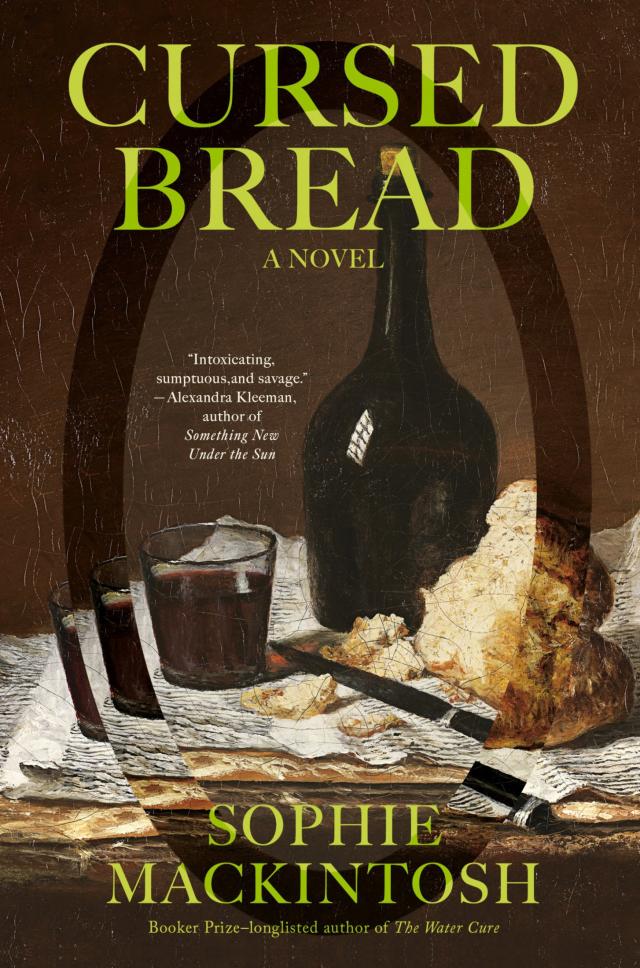
Cover image: Still Life with Bottle, Glass and Loaf by Jean-Baptiste Chardin (imitator of). Photo: © National Gallery, London / Art Resource, NY
Cover design by Emily Mahon
Library of Congress Cataloging-in-Publication Data
Names: Mackintosh, Sophie, author.
Title: Cursed bread : a novel / Sophie Mackintosh.
Description: First Edition. | New York : Doubleday, [2023]
Identifiers: LCCN 2022005436 | ISBN 9780385548304 (hardcover) | ISBN 9780385548311 (ebook)
Subjects: LCGFT: Novels.
Classification: LCC PR6113.A26493 C87 2023 | DDC 823/.92—dc23
LC record available at https://lccn.loc.gov/2022005436
Ebook ISBN 9780385548311
ep_prh_6.1_143027766_c0_r0
Contents
Cover
Also by Sophie Mackintosh
Title Page
Copyright
Dedication
Epigraph
Chapter 1
Chapter 2
Chapter 3
Chapter 4
Chapter 5
Chapter 6
Chapter 7
Chapter 8
Chapter 9
Chapter 10
Chapter 11
Chapter 12
Chapter 13
Chapter 14
Chapter 15
Chapter 16
Chapter 17
Chapter 18
Chapter 19
Chapter 20
Chapter 21
Chapter 22
Chapter 23
Chapter 24
Chapter 25
Chapter 26
Chapter 27
Chapter 28
Chapter 29
Chapter 30
Chapter 31
Chapter 32
Chapter 33
Author’s Note
Acknowledgements
About the Author
_143027766_
For Edward
Nothing’s gone, not really. Everything that’s ever happened has left its little wound.
—Sarah Manguso
When I recall the first time I met Violet, it embarrasses me. I hold the memories up to the light and think—did it really happen like this? And even if it did, why not tell it differently? More generously? Why don’t I pretend, even to myself? There’s nobody left to know, nobody who could catch me out. I could say that she came in and took my hands in hers and looked into my eyes and said she always wanted a friend, a true friend, that she could see we were alike, with twin ravaging hearts under our ribs. My dour blouse could not conceal that from her. I could say that she picked me out of everyone in the town, was drawn along the sun-bleached stone of the pavements by hunger, by instinct, to where I had always stood, waiting.
I could say a lot of things, but perhaps it’s best to be honest, now. I didn’t sense her walking towards me on that chill morning in early spring, didn’t notice her opening the door to the bakery. Her hair was dark and loose, spilling over her stiff white blouse and the lace at its collar. She hung behind the other customers, looking at the loaves stacked behind me one by one as if making an important decision. The other women in the shop greeted her. Welcome, they said. We’ve been expecting you. She smiled at that, and I had to stop myself from brushing my hand against hers when I passed her the loaf she finally chose, but I couldn’t say much to her, I was afraid of her. She thanked me and left, and through the window I saw her pause and open the paper bag for a second, as if she was considering tearing into the bread like a dog. But she didn’t. She closed the bag, and then was gone. I stared after her until the next customer, I don’t remember who, interrupted me, impatient for their breakfast. You’ve seen a ghost, they joked, snapping their fingers.
When I returned home later I found my husband asleep on our bed. He slept like a baby, insensibly, with his arms thrown out. I passed my hands over his body, not quite touching, along those splayed arms and along his legs, and finally, gently, lowered my palms to his chest. He was fully dressed. I climbed onto the bed, folded myself on top of him. His breathing changed but he refused to admit he was awake. Please, I asked him. I pressed my face into his neck. He was sweating. I wanted to put my hand over his mouth so he would stop pretending, but I knew he would rather suffocate than be caught. He kept his eyes closed. I batted at his arms, his cheeks, very lightly, then less lightly, then not very lightly at all.
I can admit that in those days I was sometimes jealous of the dough my husband put his hands into, worked so tenderly and tirelessly with, up to the elbows. I can admit now that his bread really was the best. There was such beauty in breaking it open hot from the oven and the steam pouring out, in feeling your appetite worrying at you and knowing it would soon be sated, the astonishing fact that, living as we did in this new time of peace and plenty, we might never have to feel truly hungry again. He was on a constant mission to perfect it. You might have said it was his life’s work. You might have said this not entirely seriously, but he was very serious about it. I was jealous too of the purity of his focus, the incremental moves towards one faultless loaf. But then what, when there was nothing left of the bread to improve? What then. Eat of it and be filled. Eat of it and be transformed. Eat of it and nothing changes. The almost-imperceptible recalibration of our desire, our satisfaction. Try again.
In the days that followed our first meeting, Violet haunted my thoughts. Would anyone believe me if I said I felt an intimacy with her even then? Would they believe that somewhere inside myself I knew what she would become to me? It was in the loaves I saved for her, whorled with flour. In the outfits I started to select the evening before, hanging on my cupboard door like bodies in the dark. In the slivers of information I prised out from her, prised out from the others. The matrons watched my little stabs at conversation when she came into the bakery, all my words running into each other. I was trying to be funny, showing off. We had lived in the same city for a while. We might have passed each other in the street. Through the slow afternoons I pictured her journey to us: a shining green car heading out of the city, stops on the way for her to look at the flowers in the fields. I started to wear a brooch that I had bought in that same city many years ago—pinning it to my chest like a signal. But her eyes upon it made it seem garish and unfashionable, she smiled at me without showing her teeth, and in a fit of rage I put the brooch in the bin when I closed the shop one day, sat behind the counter and cried. What have you got to cry about? my husband asked when I got home that night. He poured me a glass of milk. We live a very good life, he told me, cutting himself a thick slice of bread to eat with cheese, and it was true.
Every day I waited for her to come in, without knowing why, without knowing what I would do. Finally, a couple of weeks after she arrived, though it felt like much longer, she put a hand in her pocket one morning and drew out a piece of paper, slid it across the counter. Blue ink, the handwriting of a man. We’re having a party to meet everybody, she said. Won’t you come along? She gave me the benediction of her smile. I felt my own lips respond involuntarily. I looked down at my hands, sticky, crumbed. We’ll come, I told her.
The first time I saw the ambassador was at the lake. It was a small one, surrounded by trees, a little way out of the town. A hollowed-out copse of trees, the grass flattening vaguely into a path hardly wider than the tracks of a fox in the night. I would go there to swim just after dawn, to avoid the sinister children who threw clots of mud later in the day. Like sprites who might hold me under the surface and drown me at any moment. In the early morning I could slip my body into the world unnoticed, slip it into cold water, silken with mud, this body otherwise covered up with old cloth, apron, perfume, with layer upon layer. But that day a movement up ahead stopped me in the grass, made me press my body, still clothed, to a tree. A man, completely naked. I could see his clothes folded neatly on the ground behind him. He hadn’t seen me. He hunched his shoulders up towards his ears, loosened them, stretched his arms out in front. It was quite cold. Perhaps he was gathering courage, I thought.
He walked into the cool water until he was up past his waist, raised his arms and pushed himself in. Until he surfaced, I held my breath. I would give anything to go back and see his body for the first time again. The shock of pale, unfamiliar flesh against green leaf, the hair wet against his head. Standing on the shore h e had looked forbidding, even naked as he was, but the water washed something away from him. He became soft, glowing. He swam long and languid, and I thought of all the bodies I had known, how they had fitted or not fitted into mine, skin and breath on skin, and I lay down in the grass with the wings of the insects beating in my ears, so he wouldn’t see me. I lay until the sound of the water stilled, until I was very sure that he was gone.
Dear Violet,
It has been a year now in this convalescent place by the sea. Elderly widows and tired mothers lounge in their deckchairs on the beach, or stroll the promenade; the white paint of the buildings blisters with salt. You would never willingly come somewhere like this, which perhaps is why I feel safe here. A year of the rain tapping on the window and the hotplate in the corner upon which I sometimes consider laying my palm, though the most I ever do is drop a strand of my hair to watch it curl and smoke. I walk up and down the concrete at the seafront counting the crabs that the seagulls have smashed on the floor, comforted by the horrible way the birds address their own hunger—almost inspired by it on some days.
The policemen sit with me in my room and I make them coffee in the two cups I own. They always want me to give my account of events. I should have some fun with it, tell them something different every time, but instead I don’t tell them anything because there’s nothing really to tell, because I want them to leave me alone. I make sure they cannot see my hands shaking. My hands are where it shows. Papery rucked skin. They don’t do much of anything now, but the skin remembers, the body holds everything inside itself, the bones can still stiffen to claws. One of the policemen I think of as kind; I can tell he pities me. He says my name, then says it again—Elodie—and this makes the less kind policeman put his cup down so that it rattles. Sorry, sorry, I tell them. I’m listening, I tell them, though it’s a lie. What I am really doing is watching the sand and rain blow against the window, and how the happy families run easily to safety, striped umbrellas held like weapons. Soon the policemen finish their coffee and they go. I won’t talk, because the only real truth I could tell them is that sometimes there is a switch, and the world is turned upside down.
This is what it’s like here: I do my penance. I slide my silver coins over the counter of the café and darn my stockings and at night my eyes are swollen little beads. I am a woman talking to myself alone in a room and I am a woman mute in a police station and I am a woman in a bar who nobody pays any attention to. I am a woman talking to you all of the time, wanting to feed words back to you, because you gave me so many, pushed them down my throat until I choked and enjoyed the choking, until the words spread through my blood, until I lit up. I think in another life I could have been a pathological liar, a professional one. I could have kept audiences rapt, could have talked my way out of and into things, rather than listening, watching, ruminating until I drive myself really mad. I always did imagine the two of you as characters from a story, after all.
Our circle of women met at the lavoir once a week, Tuesdays, heaving our bags of clothes. Whatever else happened in the town there would always be bread daily and me providing it, and there would always be the weekly circle of women to meet at the water, the patterns of light playing on our faces, for we always needed to eat and we dirtied our clothes with honest work, our lives ticking over. Sometimes, not very often, I found myself tied around the throat with a hot thread of panic at the inevitability of the days, as I watched the women who were my friends moving their hands through heavy swathes of wet cloth. Mme G, Mme A, the grocer’s wife, Mme F and her daughter Josette, and the mayor’s wife. We knelt down on the warm stone in our usual places around the shimmering square of water, and steadily we moved the suds across its surface. Ivy wound its way around the pillars holding up the roof that sheltered us from the rain when it fell, though it was very dry that year. I liked to listen to the birds nesting in its corners, tucked away in the gaps underneath the cracked red tiles.
That Tuesday I waited to see whether Violet would join us. Of course she did not, though I knew the mayor’s wife had invited her. In her place, something better—Mme G, ancient and malevolent, was doing Violet’s laundry. She shook out the bag and barked Look! as if she had dug up treasure, triumphant, white hair escaping from her navy-blue scarf. We left our own things then, gathered around her as she went through each scrap of fabric in turn. We passed them from hand to hand. A silken blue blouse. A dress of light primrose cotton. Knickers, ribboned, in black, in peach, in white, some of them spotted with blood, but we didn’t recoil. We fingered the lace trims, the eyelets, the nightgown with pearlescent buttons all the way down the front. She’s small, Mme F commented critically, holding up another dress to the light, this one deep rose, not a colour I would ever think to wear. Her daughter took the dress from her, stroked the fabric lovingly.
The grocer’s wife was trying to have a baby. She told us about following the track of the moon, about the herbs her mother-in-law brewed for her, as we rinsed and wrung. She had to eat offal to conceive a boy, she had to be willing at all times, even when the grocer was drunk, even when he berated her for their difficulties. She had to remain calm and superstitious, alive to the world and all its miracles. I’m praying to the Madonna, she said, pious. Try praying to someone who isn’t a virgin, said Mme A darkly, and all of us except the grocer’s wife laughed. But even her predicament was not enough to distract them from Violet for long. I listened to their rumours, my eyes on my own clothes, heavy with water.
She orders her groceries in hampers from the city.
She bathes in milk and rose petals.
She sits out on the balcony all night, doesn’t sleep.
The ambassador rescued her from an asylum.
She was a cabaret singer.
She was a whore.
She invited me to a party, the grocer’s wife volunteered, almost guiltily.
Me too, I said.
Mme G lowered herself into a crouch, with difficulty, next to the water. You must tell us what you find out, she said. We’re counting on you young ones. With a leisurely, graceful violence, she hit a white bed sheet against the surface of the water and left it to soak. The grocer’s wife smiled at me. I would always be one of them, nobody looking at me could deny it. With teeth hard in my mouth, the curve of my long neck, and my hair strong, bleached every four weeks like clockwork, my head tipped over the sink as I sluiced burning ammonia down the drain. My feet were flat. My hips were wide. I was bloody all the way through. I didn’t have to say it out loud; the women nodded their heads. They understood that much, at least.
When I stepped into Violet’s house for the first time, I felt something glassy and sharp high in my abdomen. It was a house that had been empty most of the year, tucked away down a backstreet, and now it was full of lilies and irises, their petals cool and sweet, and lit up with dozens of candles. She must have spent all day arranging it. My eyes darted, taking everything in. Despite the flowers, despite the floorboards waxed to an exacting shine, I fancied I could smell the damp that still lingered underneath, even the acrid smell of mice, and this pleased me. I spotted the grocer’s wife and the mayor’s wife with their husbands, across the room, wearing dresses I knew were their best, but which seemed old-fashioned even to me—too long, too shabby, too loose on the waist. On the other hand, Violet was overdressed in a way that would have been laughable on anybody else—in black velvet, a tight diamond necklace, both too grand for the occasion, her dark hair swept up.
Have a drink, she ordered, raising her hand, drifting away before I could reply.