

Eos, p.1
Eos, page 1


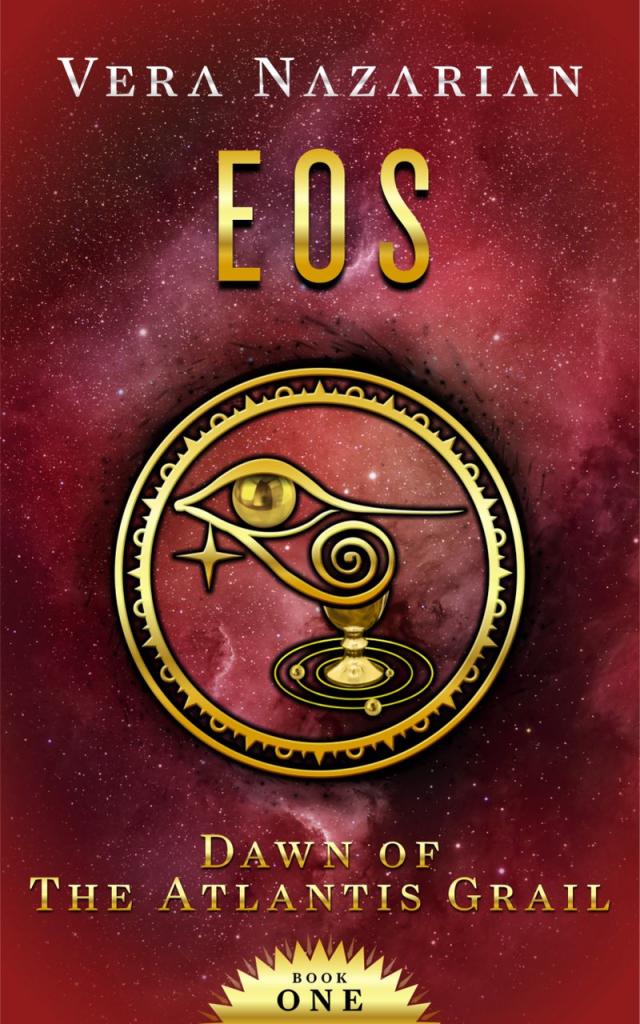
EOS - DAWN OF THE ATLANTIS GRAIL
A mysterious vigilante meets Scheherazade in high-tech Ancient Atlantis, set against the backdrop of an impending global apocalypse.
On the last day of Atlantis,
When it sank beneath the waters,
Sons and Daughters of Atlantis
Sailed their ships toward the stars.
Earth, 10,504 B.C.E.
A deadly asteroid sent by alien gods is about to strike Ancient Atlantis.
In the high-tech Imperial capital, Poseidon, the decadent ruling elites rush to build ark-ships to flee to the stars, leaving the impoverished masses to perish when the Sky Rock hits—with one exception. The Imperial Kassiopei Dynasty and the noble Great Houses hold Service Competitions to pick those best qualified to serve them.
Street-smart sixteen-year-old Semmi, fired from her darkness shift job at an industrial warehouse, witnesses a mysterious vigilante known as the Man in the Niktos Cloak and accidentally discovers his impossible secret identity.
Powerful nobleman by day—deadly vigilante by night—and the anonymous star of the most popular and hottest adult drama on Atlantean video, Benaten Bisfuri is an irresistible man of many contradictions.
To keep his secrets, and keep her quiet, Benaten must hire Semmi to work for him. Desperate for employment, and frightened for her family, she must accept the job. Soon, she’s embroiled in Imperial Court politics and a complex plot to save the people who will be left behind—all while competing in the brutal Service Competitions to earn a coveted spot on an ark-ship. She also finds her fate entwined with the uncanny Imperial Princess Arlenari who just might hold the key to everyone’s salvation.
Before the Sky Rock strikes Earth—bringing about the Great Flood, reprising an Ice Age, and changing the face of the planet forever—Semmi must discover her own abilities to win a place for herself and her loved ones.
A place on the Ark.
EOS is book one of the series Dawn of the Atlantis Grail.
Don’t miss another book by Vera Nazarian!
Subscribe to the mailing list to be notified when the next books by Vera Nazarian are available.
We promise not to spam you or chit-chat, only make occasional book release and special news announcements.
CONTENTS
Author’s Note
Chapter 1
Chapter 2
Chapter 3
Chapter 4
Chapter 5
Chapter 6
Chapter 7
Chapter 8
Chapter 9
Chapter 10
Chapter 11
Chapter 12
Chapter 13
Chapter 14
Chapter 15
Chapter 16
Chapter 17
Chapter 18
Chapter 19
Chapter 20
Chapter 21
Chapter 22
Chapter 23
Chapter 24
Chapter 25
Chapter 26
Chapter 27
Chapter 28
Chapter 29
Chapter 30
Chapter 31
Chapter 32
Chapter 33
Chapter 34
Chapter 35
Chapter 36
Chapter 37
Chapter 38
Chapter 39
Chapter 40
Chapter 41
Chapter 42
Chapter 43
Chapter 44
Chapter 45
Chapter 46
Chapter 47
Chapter 48
Chapter 49
Chapter 50
Chapter 51
Chapter 52
Chapter 53
Chapter 54
Chapter 55
Chapter 56
Chapter 57
Chapter 58
Atlanteo Glossary
Other Books by Vera Nazarian
About the Author
Acknowledgments
EOS
DAWN OF THE ATLANTIS GRAIL
BOOK 1
VERA NAZARIAN
COPYRIGHT PAGE
This book is a work of fiction. All characters, names, locations, and events portrayed in this book are fictional or used in an imaginary manner to entertain, and any resemblance to any real people, situations, or incidents is purely coincidental.
EOS
(Dawn of the Atlantis Grail, Book One)
Vera Nazarian
Copyright © 2025 by Vera Nazarian
All Rights Reserved.
No part of this work may be reproduced, distributed, stored on any media, shared, or transmitted in any form or by any means, electronic or mechanical or any other method, without the prior written permission of the copyright holder and publisher.
Cover Design (created in 2020) by James, GoOnWrite.com
Original Logo created by Vera Nazarian incorporated in design.
No AI software was used in the creation of this cover or book.
Digital Edition
August 5, 2025
Rev. 0.0
Published by Norilana Books
P. O. Box 209
Highgate Center, VT 05459-0209
https://www.norilana.com/
United States of America
For Susan Franzblau
With love, gratitude, friendship,
and immense appreciation, always.
AUTHOR’S NOTE
The following terms for time and temporal intervals are used in the series Dawn of the Atlantis Grail:
“of Ra” is equivalent to AM.
“of Khe” is equivalent to PM.
“Daydream” is equivalent to minute.
“Heartbeat” is equivalent to second.
CHAPTER
ONE
Earth, 10,504 B.C.E.
January / Month of Setaet, 14th Day.
98 days until Impact.
Before the world falls apart, before the gods send us death and destruction, it all begins quietly . . . with mushrooms.
I chop mushrooms.
I have only one accursed job, and it is dreary, monotonous, and without end.
It’s not even dawn when my daily shift begins in the warehouse district of Poseidon—great City of Sacred Circles, Imperial Seat of all power of Atlantis—in one of the immense, climate-controlled kitchen pantries of Chiprahat Exquisite Foods.
From the dismal darkness of fourth hour of Ra until noon, I stand leaning over a long work table. It is lined with industrial cutting boards, racks of cook knives of all sizes, and enormous wooden bowls filled with different fungi varieties.
The mushrooms range from the cheapest, commonplace round buttons and many-headed wild bunches, to the ones with slim stalks and wide-brimmed hats, and everything in between.
Some mushrooms are formed in elegant, tiled colonies. Others exhibit patterns of divine symmetry found in sacred temple architecture—so we’re told. And yet, it’s the most ugly and misshapen ones, resembling earthy lumps, that are priceless. And my duty is to handle all of them accordingly, in their own particular ways.
On both sides of me are other workers, mostly women, girls, and underage boys. And we constantly elbow each other by accident, since we’re packed together like locusts, with little room to move. Minor accidents happen but, because we deal with sharp knives, everyone soon learns to handle their cutters with skill.
You either learn precision and dexterity or lose this job. That’s because the workroom is sterile (something akin to being thoroughly cleansed by the gods) and there are strict rules. Cool, moist air, of a precise temperature conducive to mushroom well-being (and fortunately, ours) is pumped into the room. We all have to be cleansed at the entrance and wear uniform aprons and hair caps of strange, fancy linen.
Anyone who cuts themselves enough to draw blood has to abandon their cutting board and contaminated batch of mushrooms, leave the shift, and lose the remaining day’s pay. Yes, you can come back the next day with a proper sterile bandage, but you’ve just earned your first reprimand. Each worker only gets three before they’re dismissed permanently.
The pantry is brightly lit with overhead orb lights. A few hovering orbs can be called at need to provide focused, bright illumination during particularly delicate tasks. However, they are annoying, since they tend to float near your face and bump the top of your head like low-hanging fruit, so I don’t bother.
The thick smell of loamy, pungent earth, rich with mycelium spores, fills my nostrils every time I enter the pantry. Overseers stroll through the room every so often, observing us work, and needlessly reminding us to pick up the speed, to meet our quotas.
Upon the hour, every hour (announced loudly by the overseers), delivery workers arrive from the specialty mushroom farms and grow-houses with fresh new containers to refill the dwindling contents of our bowls. They remove our finished chopped batches.
Accursed, never-ending mountains of mushrooms. . . . Bastet, forgive me for thinking ill of my blessed source of livelihood.
Blessed mushrooms. (Is that better, Holy Bast?)
Once sorted, a few remain here on the storage shelves for aging and drying. The rest are taken away from the facility. Some will go to the local exclusive, high-end eateries to be prepared into artisanal delicacies for the wealthy restaurant and grocery patrons. Others end up in the industrial kitchens next door for the mass production stage. Of their final fates, I am not quite certain. . . .
By the end of my shift, not only are my wrists and fingers in pain, my back aching, but my lungs are choked with the pungent mushroom miasma which fills the room. Why don’t they use automated machinery to cut these precious and accursed things, one wonders? Because human labor is cheaper than the proper upkeep of industrial tech.
And so, the girls and women around me moan with weariness as we clean up for the day, put away our knives, and prepare the work surfaces for the second shift that will arrive here at first hour of Khe and stay until the night darkness of ninth hour.
That darkness is inevitable. Whichever shift you get, you either arrive with it or depart into it. Often, we curse our fates that we must work the darkness shifts, just as much as we thank the gods for giving us free employment in an air-conditioned room, as opposed to serfdom or slavery.
In addition, many of us curse the enforcement of the new Rules of Humane Consumption that require the whole of Poseidon’s Sacred Circles and indeed, the whole mortal world, to only consume plants—fruits and vegetables, fungi, legumes, grains, and the seeds of the earth.
Humanity is no longer permitted to eat meat.
Hence, the mushrooms, a rich source of flavorful protein to substitute the flesh of beasts and cover our nutritional needs. What is “protein?” What are “nutritional needs?” Supposedly, it’s what alleviates hunger and keeps us alive.
I know little about it, only what we’ve been told by the learned ones—the singing voice techs who run all the machines and technology of Atlantida on behalf of the noble elites and the Imperial Kassiopei Dynasty. I often wish I knew more, but then, as Grandmother says, with most things in this world, I would probably end up knowing just enough to regret it. Besides, schools are not for the likes of us.
And neither are mushrooms.
Everything started just a few years ago when they arrived—the gods.
And by “gods” I don’t mean our current divine rulers, the Imperial Kassiopei (may their ancient Dynasty Name be Eternally Blessed, as far back and forward as it goes, unto the Ages), but the others.
From the sky. . . .
These nameless others, golden gods made of pure light, dropped from the vault of Ra’s heaven like flaming stars and taught us the true ways—the standards of goodness and virtue.
“Taught” is the wrong word. They forcefully insisted we make the changes in our lives and return to infinite clarity (whatever that means), upon pain of punishment and destruction. Which they swiftly demonstrated when anyone disobeyed.
Explosions . . . screams of agony . . . people incinerated . . . buildings turned to dust. . . .
Even our divine Imperial rulers had to pay heed to them, since they too are only mortal men like the rest of us, regardless of what the priests teach.
Holy Bast, was it only four years ago?
Feels like it’s been a lifetime since the last time I ate a proper bite of goat meat stew or skewered and charred pieces of lamb. Not even rabbit or rodent flesh is allowed. No fish from the ocean, no insects, nothing that moves of its own accord or visibly suffers when killed or harvested. And least of all, bulls or cows. Those were already half-sacred, and the occasional partaking of their flesh was reserved for the rich and noble, even before the golden gods upturned our world.
Amurabia, my Grandmother, insists it has indeed been one fourth of my lifetime since the golden gods came. I can only count on my fingers and toes, so I’m not quite sure what that means as far as my own age.
I might be seventeen winters but only sixteen summers, because I was born soon after harvest time, at the end of the month of Hekaet—which, according to Amurabia, makes me sixteen years old (ten fingers and six toes; that much is certain).
All I know is that I may already be of an age to marry, which sickens me. I dread the thought of leaving our poor but familiar home. I would be leaving Amurabia and little Urumer, my seven-year-old baby brother, and the stupid, useless Guzum, our misfortunate Father whose name I prefer to say as few times as possible.
As a married woman, I would be going with some smelly goat of a man to live in a strange hovel with his family and clean up his filth after him . . . in addition to letting him rut inside me and fill me with pitiful children.
So instead, I choose to chop (and carve, and grate, and eviscerate) mushrooms—for which I thank Bast and praise Bast (and occasionally misuse her name during cursing; forgive me, Holy Bastet, Thou Whose Glory Shines Brightly).
And I remind myself of my fortune every time I wake up in the abysmal pre-morning darkness and hurry through the treacherous streets in the outermost Circles of Poseidon, traveling inward to Circle Eight and the sprawling Chiprahat building. The alternative to chopping mushrooms would be a much darker fate.
I know it will catch up with me at some point. Yes, I will be sold to a smelly man-goat or boy-goat . . . but not just yet.
Amurabia is still mam-ra, still the mistress of our household, no matter that it’s tiny and impoverished, and my pathetic Father must listen to her or be denied the sharing of our home.
Since my Mother, Eigeti, became deathly ill and boarded the Depet of Eternity during last year’s great plague, he has no claims left upon us. As a provider he is sadly lacking, and his random work in the markets is as unreliable as the weather outside Poseidon’s outer Circle boundary. We’re lucky if he brings in a single metal coin every three days.
Amurabia would have to choose to sell me herself, and she would not do so, I’m certain, since she cherishes us dearly. My little brother and myself are all that remains of Eigeti—beloved Eige, her departed daughter.
And besides, both Urumer and I work well, and we bring in metal coins every day. I do the mushrooms while Uru runs errands around the marketplace districts on foot or using his cheap hoverboard. Amurabia would be an old fool to dismiss either of us for a one-time lump sum. And if she is gone, and it remains up to my no-good Father, he might still choose to rely on my steady earnings.
Why do I dwell on all this? Am I worried? Not in the least . . . at least for now. I trust the secure household of my Grandmother (may she live longer than the Imperator—Holy Bastet, hear me; I spit three times upon the ground to distract the evil sha eye). And I am confident of the solid meal we have every day as a family.
All things considered, the mushroom work is tolerable. Admittedly, at some point, I hope to actually taste for myself the miraculous mushroom meat they make for the noble and rich. Sadly, I’ve never eaten mushrooms, despite knowing every fungus variety and precisely how to handle each kind.
Furthermore, I’ve never stolen a single mushroom, even though some girls who work my shift have done so, I’m certain (such as Jigudin or the shameless Labaat who has a hidden pouch sewn in her skirt) because I cannot risk this job. And because . . . I don’t steal. It’s a matter of pride in my family; Grandmother taught me and Uru well. We may be poor, but we never stoop to the dishonor.






