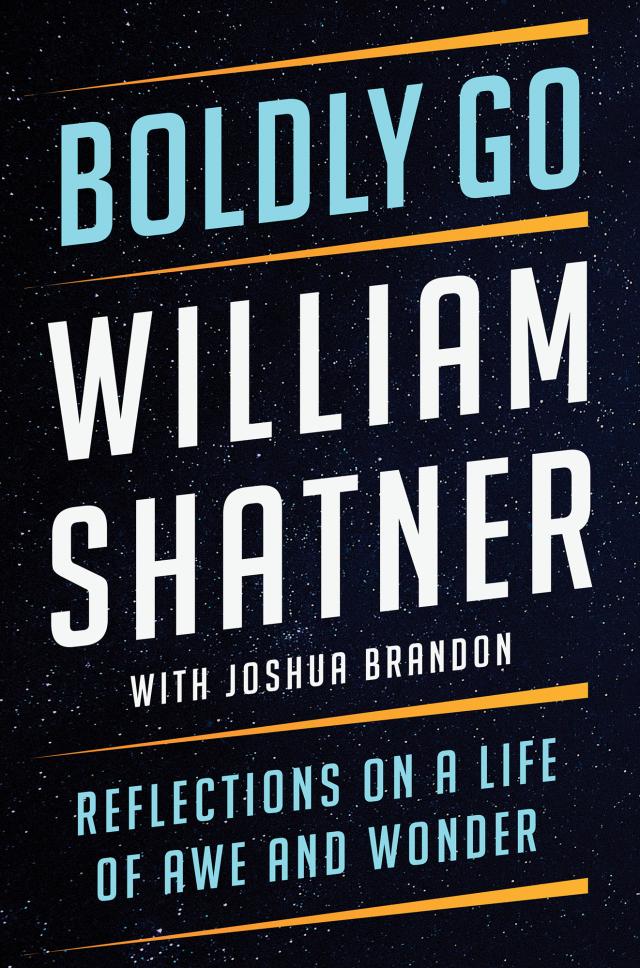
Boldly go, p.1
Boldly Go, page 1


Thank you for downloading this Simon & Schuster ebook.
Get a FREE ebook when you join our mailing list. Plus, get updates on new releases, deals, recommended reads, and more from Simon & Schuster. Click below to sign up and see terms and conditions.
CLICK HERE TO SIGN UP
Already a subscriber? Provide your email again so we can register this ebook and send you more of what you like to read. You will continue to receive exclusive offers in your inbox.
My family—which includes my daughters, my sons-in-law, and grandchildren—has a new member. His name is Clive. Clive is a step into the future. Unbeknownst to him, the world is changing rapidly. The recipient of all those changes will be Clive. This book is dedicated to the Clives of the world, who are being born into a maelstrom of activity. If we are diligent enough given all the new, wonderful things that are being invented even as you read this book, the world as we know it may continue to exist. That will be up to Clive and company. I wish them well.
The cosmos is also within us. We’re made of star-stuff. We are a way for the universe to know itself.
—CARL SAGAN
INTRODUCTION
Knowledge feeds me. It’s as necessary to my existence as oxygen. It thrills me.
Long before Gene Roddenberry put me on a starship to explore the galaxy, long before I actually ventured into space, I had been gripped by my own search for knowledge, for even a fraction more understanding than I’d had before. Perhaps, even more, for meaning. If I never succeed, never discover the answer to the age-old question of why, to be always learning, always wondering… well, the quest itself keeps me vital. I get a tingle down my spine when I’m presented with an opportunity to learn something new, a daily occurrence for me, even at ninety-one years old. Open your eyes, your ears, your mind, and you’ll quickly be overcome by the wonder that surrounds us. I am never so thrilled as when the word wow escapes my mouth. It’s an almost involuntary expression of childlike delight at learning something new. I probably say wow more now than when I was a child, and I am absolutely enchanted by that fact.
These wow feelings are not all intellectual. I could sit at home reading, hour after hour, immersed in knowledge, but that’s not enough. To me, experiences must be felt. They must be lived. We need to reach out for love as well as fear if we want to stay vibrant.
Shortly after my ninetieth birthday, I went swimming with sharks—in the most dangerous and frightening of ways. I was invited to be a featured guest on an episode of Shark Week. My philosophy has long been to say yes to new possibilities. The adage that you’ll regret the things you didn’t do may be a cliché, but I really believe it, so I strive to answer the phone when opportunity calls. Soon after accepting the offer, I found myself on a boat, ready to go into the water with fifteen-foot tiger sharks—some of the most ferocious beings in the ocean, second only to the great white.
The dive organizers had dressed me in a wet suit, complete with scuba gear. I had dived many times in my life, so I was familiar with the accoutrements, but my previous experience could not have prepared me for what lay ahead, and what lay beneath. The guides threw ground bait (or chum) out onto the surface of the water to attract the fish they were looking for. In this case, sharks. Right away, we succeeded in enticing some smaller sharks to the surface.
“There are two difficult points in this exercise,” announced our Bahamian guide, Neal Watson. “Going into the water, and coming out. Because all of these sharks on top of the water are looking for chum, and if they think you’re their chum, they might bite your ass.”
Great. These chummers are not really my “chums” in the traditional sense, I thought.
“You take the same risk getting out of the water, because the last thing to disappear out of the water is your ass, so they might want to take a bite out of that.”
Wonderful. I dropped down into the water and sank forty feet to the ocean floor. Right in front of me were four massive tiger sharks. Suddenly, being on the surface with my “chums” didn’t seem so bad. Neal came down with us, and I felt a modicum of comfort knowing he’d spent his whole life doing this. He was a real pro.
Then again, my brain chimed in, things only have to go wrong once.
In front of us, one of the handlers fed the sharks to keep them in the area (it’s better TV if they don’t swim away). I watched as each shark made a beeline for the handler, who would pull out of the way at just the last minute, allowing the shark to grab its food and pass by.
I sat down on a rock in the sand, watching with awe and a great deal of fear as these massive creatures swam around me. When they opened their mouths, the sharks appeared to have fangs that looked like something out of a horror movie. One of the handlers had positioned himself behind me, and later explained he did so because tiger sharks are ambush predators, who like to circle around and get you from behind. He literally “had my back” to prevent an attack from the rear. Fantastic.
At one point, the tiger sharks started coming toward us, taking particular interest in one of our cameramen. One moved at him like a charging dog. I was able to think only two things in that moment. First, At least the shark isn’t charging toward me! And second, What the hell am I doing down here at ninety years of age swimming with sharks? Why on earth am I doing this?!
The best answer I can come up with is that I don’t know how not to be doing. I really would regret not giving myself a chance to experience something new and to learn in the process. I’ve spent my entire life taking what seem to be unnecessary risks. I’ve done things that should have killed me. I’ve been skydiving, even though I’m afraid of heights; I literally screamed all the way down. My fear of doing it was very real, but my fear of not doing it was worse. It’s as if I have an inverted instinct for danger. My mind doesn’t run screaming away from it; it somehow forces me to run toward danger.
Years ago I was making a film called Disaster on the Coastliner, starring Lloyd Bridges, Raymond Burr, and other heroic actors of the age. We were shooting on a deserted Connecticut rail line, which we were using for a big action sequence with a moving train. (You didn’t think I was going to give you the whole shark story up front, did you? I’m an actor; we have to create suspense!)
In Disaster on the Coastliner, my character had to run across the top of the train, making a mad dash across to the engine compartment to rescue Paul L. Smith’s character, all the while being pursued by a helicopter. This was clearly going to be a hell of a stunt.
I asked the director, Richard C. Sarafian, “How are you going to shoot this?”
He said the stuntman would do it in the wide shot, then he walked over to check the camera setup. Okay, but I really wanted to know how he was going to do the close-up.
I watched the stuntman, and I can tell you, this was one brave guy. The train was going about forty miles per hour, and he was bent over against the wind. Now, I’m a pilot, so I could tell that the stuntman was creating an airfoil—the wind coming at him was lifting him slightly off the surface of the engine. It’s not dissimilar to flying a single-engine Cessna 150; once you’re going about thirty to forty miles per hour, you already start to get lift. It must have been terrifying for the stuntman—he was basically a light aircraft at this point, with none of the controls!
They got the shot and it looked terrific.
Now I said to the director, “Okay, how are you going to shoot me in this scene?”
He wasn’t sure. “Background projection, most likely,” he decided, which meant going back to the studio, building a train rig, and simulating the effects of it moving with lights, wind machines, and other Hollywood gimmickry.
This is where my inverted instincts suddenly kicked in. “Well, you know,” I said, “I can get on top of that thing, if you want.”
The director’s eyes lit up. “You can?”
“Sure!” I exclaimed with undue confidence. “How fast is it going to go?”
“Well, it doesn’t have to go faster than ten miles per hour.”
“I’ll do it. I’ll get on top of the moving train.”
So, there I went. Up on top of this locomotive—a Diesel. It’s important that you know that it’s a Diesel, since those things are built in such an aerodynamic way that there are no protrusions on the curved surface of the cars. There is nothing to tie cables to, so there were no cables attached to me. I was up there completely alone. No harness. No net. Let’s face it, no brain. Frankly, I can’t believe they let me do this. There is no way this would happen today, whether I’m William Shatner or William Jones. It just isn’t done. But back in Connecticut in 1979 with a crazy ambitious director and my own inverted instincts for danger, there I was.
The train started up, the helicopters—one to chase me, the other one to film the first one chasing me—rose into the air, and we did the scene. I was running across the train like my life depended on it (it did), giving my absolute all as an actor to this scene and this thoroughly ill-advised stunt.
We finished the scene; the train came back to the starting point; I climbed down and walked over to the director.
“How was it?” I asked eagerly.
“It was great. It was terrific,” he said.
* * *
There’s no greater feeling as an actor than when the director tells you that you’ve done a good job. You live for that feeling, that validation, knowing that in your continued pursuit of perfecting your craft, the work you do will—
But there was something amiss. A look in the director’s eye.
“What is it?” I asked, f oolishly.
He hesitated. “Well…” he began to reply.
Well. It’s just like but. You know the rest of that sentence isn’t going to be good. You know your days of running across a moving train haven’t ended.
“It looked like the train was going at ten miles per hour. And if we speed up the film too much, it’ll just look goofy.”
Again, those anti-instincts kicked in.
“Let’s do it faster,” I suggested.
I got back on the train; they took it up to twenty miles per hour. I did the whole thing again, twice as fast. Twice as scary. We finished the scene and I climbed back down.
“How was that?” I asked breathlessly.
“It was great. It was terrific. You were incredible!”
I was thrilled, the exhilaration of a job well done reverberating through my body. This was why I’d acted; this was why I had devoted my life to my craft, to—
That look again on the director’s face.
“What?”
“Well… it looked like you were going twenty miles per hour.”
I eventually did the stunt at the full forty miles per hour like the stuntman, running across the train, under a bridge, around a curve, two helicopters following. I even had to stand up and reach for one of the helicopters at the end, so they could cut to the wide shot of the stuntman climbing into the helicopter to escape certain death on top of that train from hell.
When the stunt was over, I thought, This was the most incredibly stupid, idiotic thing I could have done.
Which brings me back to those sharks.
They made a beeline for the cameraman. Was he going to capture his own mauling on film? No, it wouldn’t seem so. Neal calmly moved the sharks aside; he knew just how to guide them. These were enormous, dangerous creatures with fangs, and he just moved them over. It was an incredible thing to behold.
We were also accompanied by Cristina Zenato, a lady we affectionately called the “shark whisperer.” Cristina was so in tune with the sharks that she could command them to obey her, in a way. She had first gone to the Bahamas as a tourist almost thirty years earlier and found her calling. She stayed and became a shark expert.
Cristina showed us how she could put the sharks into what is termed tonic immobility (or “tonic shock”)—a peculiar quirk whose reason for existing in nature I don’t entirely understand. Essentially, Cristina could turn a shark upside down and stroke its belly, causing it to lapse into a strange hypnotic sleep. Apparently, orcas use this technique to turn great whites upside down, pet their bellies until they are in this trance, and then eat their livers. Some birds have a similar impulse: if you put them on their backs and stroke them, they’re immobilized, often out of fear that a predator is going to eat them, making their best bet to stay still and play dead.
Cristina guided one of these immense creatures over to me; it was so docile under her command that she put it on my lap. (I’ve got a shark on my lap! What the hell am I doing here?!)
I found myself petting this beautiful being. The rest of the crew were wearing chain mail–type suits, but for some reason they’d figured I didn’t need one, so I was able to feel the quality of the shark’s skin and touch its fins. Then, I inadvertently put a finger near its gills, and bam!—it swam off. It wasn’t immobilized; it could have chosen to take a bite out of me, if it had wanted to.
About ten minutes later, Cristina coaxed another shark over and I stroked this one as well. Perhaps it was immobilized by fear, but I prefer to think it was mesmerized by love. By touch. By a deeper connection that I can’t explain. I believe with all my soul that it’s there.
In that moment, stroking the belly of this shark, whose skin felt like a strange, rough carpet, my fear disappeared. I remembered what the hell I was doing there. I was learning. I was communicating. I know in my heart that these sharks could tell I was not a threat, and they responded with love.
When it came time to return to the boat, I wound my way up through the multitude of sharks, while the smaller ones were still chumming overhead. As I got above the surface and safely out of reach—my derriere the last piece of me to disappear out of the water—I could have sworn I heard one of the sharks say to another, “Get a load of that asshole.”
It was an incredible, frightening, wonderful experience. You could say I haven’t learned my lesson. Or you could say I’ve learned a different lesson. Dare I say a better lesson? For me, perhaps. Let’s be clear: I’m not advocating for you, dear reader, to go swimming with sharks or run across moving trains without a safety harness. The lawyers would like me to make that clear. We want you to stay nice and safe—and to buy more of my books. Have you read Shatner Rules?
We are often reminded to stop and smell the roses. I have to go further. Stop and smell everything. Smell the roses, smell the grass, smell the weeds.
Wait… Shatner wants me to smell the weeds?! That’s how I’m supposed to live? Well, I’m ninety-one years old; how old are you?
My point is that there is beauty all around us, and there is something ineffable about taking it all in—including the weeds—especially when you stand back to contemplate that those weeds are made of the exact same “star stuff” as we are, as Carl Sagan so famously put it once. The weeds in the ground, the air we breathe, the animals with whom we share bonds, the stars in the sky… they’re all made of the same atoms, and they’re likely all connected in ways we can’t even yet imagine. Honestly, just thinking about that gives me chills. How can your body not want to keep you alive for as long as possible when all these opportunities exist for you to behold on a daily basis?
If you allow yourself to be awed by life, to keep drinking in its limitless knowledge, to keep striving for answers, to enjoy the beauty around us at every moment, to never stagnate… well, then you might find yourself living for a very long time, and ideally, prospering. Or in the absence of the longevity and self-defined prosperity you seek, you might well find meaning, or even better, happiness.
— CHAPTER 1 — WE BELONG TOGETHER
I heard a story once about a young John Lennon. In his school days, a teacher supposedly asked the class the question, “What do you want to be when you grow up?” The teacher was likely expecting the usual range of answers: a doctor, a lawyer, an astronaut, or even, heaven forbid, an actor. But ever precocious, young Johnny is said to have replied, “Happy.” The teacher told him he hadn’t understood the assignment; according to Lennon, he replied that the teacher didn’t understand life.
What makes us happy, or sets up the conditions for us to be able to experience contentment? What allows us to form connections with each other and the world around us? These are questions that have fascinated me for a long time. I truly believe that we are bound to each other and to the fabric of the universe, down to the microbe, down to the atom, and everything contained therein. We see evidence of it every day. If one species is displaced from our delicately balanced ecosystem, there will be damage to the whole planet. If essential connections between human beings are disrupted, damage to those human beings will occur on every level.
At our most fundamental, we exhibit an essential aloneness. We begin alone in the womb; as we emerge, we are alone until gathered up by, ideally, loving people who constitute, in most cases, our immediate families, and we are bonded to them. We then go through life testing the strength of those bonds, through distance, disagreements, diverging interests. Each of those tests can have the effect of allowing that essential aloneness to resurface. Between our births and our inevitable deaths—both events we will experience alone—we try to fill those gaps with social elements. We are born into (or from) some sort of familial unit, and then most often we seek to create our own, whether through offspring or friendships, driven by a societal link to others. We surround ourselves with people and things and identifications, offering opportunities to avoid feeling so alone.
The origins of our desire to break away from aloneness can be traced back to human evolution. Hominids who banded together to form tribes found that their chances of survival increased significantly over those who didn’t mob up, and who later ceased to exist. This cooperation started as a means of survival, but perhaps it unlocked innate empathy and sympathy in our DNA. We see it in other animals that cooperate but also care for each other. Dolphins have been known to assist their females during pregnancy in a midwifery fashion; lions are often raised together in nurseries within a pride. The essential bond of cooperation and family is everywhere.