

The golden boy, p.1
The Golden Boy, page 1


This is a work of fiction. Names, characters, places and incidents are either the product of the author’s imagination or are used fictitiously. Except where expressly noted, any resemblance to actual persons, living or dead, businesses, companies, events or locales is entirely coincidental.
Copyright © 2026 by Patricia Finn
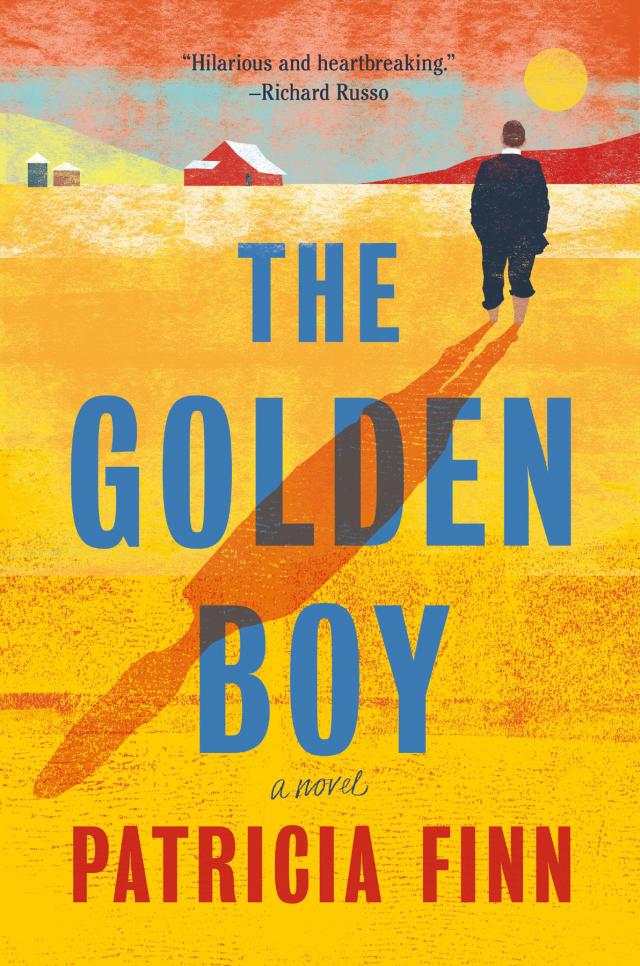
Cover design by gray318. Cover copyright © 2026 by Hachette Book Group, Inc.
Hachette Book Group supports the right to free expression and the value of copyright. The purpose of copyright is to encourage writers and artists to produce the creative works that enrich our culture.
The scanning, uploading, and distribution of this book without permission is a theft of the author’s intellectual property. If you would like permission to use material from the book (other than for review purposes), please contact permissions@hbgusa.com. Thank you for your support of the author’s rights.
Cardinal
Hachette Book Group
1290 Avenue of the Americas, New York, NY 10104
First Cardinal Edition: March 2026
Cardinal is an imprint of Grand Central Publishing. The Cardinal name and logo are trademarks of Hachette Book Group, Inc.
The publisher is not responsible for websites (or their content) that are not owned by the publisher.
The Hachette Speakers Bureau provides a wide range of authors for speaking events. To find out more, go to hachettespeakersbureau.com or email HachetteSpeakers@hbgusa.com.
Cardinal books may be purchased in bulk for business, educational, or promotional use. For information, please contact your local bookseller or the Hachette Book Group Special Markets Department at special.markets@hbgusa.com.
Print book interior design by Marie Mundaca
Library of Congress Cataloging-in-Publication Data
Names: Finn, Patricia (Novelist) author
Title: The golden boy / Patricia Finn.
Description: First edition. | New York : Cardinal, 2026.
Identifiers: LCCN 2025043778 | ISBN 9781538776186 hardcover | ISBN 9781538776216 ebook
Subjects: LCGFT: Novels | Fiction
Classification: LCC PR9199.4.F553 G65 2026
LC record available at https://lccn.loc.gov/2025043778
ISBNs: 978-1-5387-7618-6 (hardcover), 978-1-5387-7621-6 (ebook)
E3-20260123-JV-NF-ORI
Contents
Cover
Title Page
Copyright
Dedication
Epigraph
Part One Boulesis Rational Desire Chapter 1 Houses
Chapter 2 Games
Chapter 3 Expectations
Chapter 4 Secrets
Chapter 5 Temptations
Chapter 6 Diversions
Chapter 7 Shame
Chapter 8 Despair
Chapter 9 Goodness
Part Two Epithumia Irrational Appetite Chapter 10 Illusion
Chapter 11 Perfection
Chapter 12 Duplicity
Chapter 13 Division
Chapter 14 Friendship
Chapter 15 Compulsion
Chapter 16 Judgment
Chapter 17 Appetite
Chapter 18 Hope
Chapter 19 Treachery
Chapter 20 Pursuit
Part Three Thumos Courage Chapter 21 Decision
Chapter 22 Fear
Chapter 23 Fate
Chapter 24 Evil
Chapter 25 Horror
Chapter 26 Truth
Chapter 27 Love
Chapter 28 Justice
Chapter 29 Mercy
Epilogue
Author’s Note
Acknowledgments
Discover More
About the Author
For Joseph, who saw the race.
Explore book giveaways, sneak peeks, deals, and more.
Tap here to learn more.
For without friends, no man would choose to live.
—Aristotle, Nicomachean Ethics
PART ONE
Boulesis
Rational Desire
CHAPTER 1
Houses
For even a house is a sort of public monument.
—Aristotle, Nicomachean Ethics
Tuesday, March 4, 2003
Maui
IN HIS LATE FIFTIES, Stafford Hopkins began to wake up crying. Agnes had only recently returned to his bed and he could not think of a tactful way to mention this without sending her back to the pool house. He knew she would assume that men who cry in their sleep are unhappy men, and the unhappiness of others was, to her, a personal issue. There would be blame, first determined and then assigned, and it would happen suddenly. Unassigned blame frightened his wife, and he had learned to live with that, accepting it as he did his need for her presence in his life. He did not know if he still loved her, but assumed it was no longer necessary for him to know, because he was a successful man, his happiness maintained by diet, exercise, and well-planned trips to fine places. They had many friends, he and his wife, and they were managed carefully like other things. It had been a long time since anything in their lives was left to chance, and they had always been in agreement that it did not pay to be careless.
When they built the retirement property on Maui then, and he told her abruptly and without warning that he wanted to sell their other houses, the prospect frightened her. They fought for months, house by house, until he finally gave in and came, she said, to his senses. They had lived in Los Angeles for thirty years, she said. LA was home. Yes, she knew he had left the network. She was dimly aware of that. But he was still in demand as a creative consultant and business adviser on large projects and important industry matters, was he not? So where exactly would they stay when they returned to LA for meetings and parties and award shows? Where would they go if they had no house of their own in the city? Or did he think she would stay alone in Hawaii and he would fly back and forth when it suited him, staying in hotel suites like an outsider, a junior executive? He was being selfish, which was normal, but he wasn’t thinking, which was not.
They had, after all, already downsized from the big house in Bel Air to the penthouse in Beverly Hills, and it was no trouble to maintain it at this point, none whatsoever. The little beach house in Malibu was well managed as a rental property and cost them virtually nothing to own. The apartment in New York was a financial asset whether they ever stayed there again or not. And as for their winter house, the house in Aspen that he always claimed to dislike so much? Well, that house, she said, that house had become too valuable to sell and it would not be fair to their daughter to sell it now, because it could not be replaced. Besides, she said, they both liked to see snow in the winter, did they not? Wasn’t that why they’d bought the Aspen house? Wasn’t that why they’d spent Christmas and New Year’s there for the past twelve bloody years? It had become a tradition, and traditions couldn’t just be tossed away like they were nothing—like they were magazines or old shoes.
This last argument had made him laugh, and she had surprised them both by not crying when he mocked her.
“When did this word tradition slip into your vocabulary?” he asked. “And are you sure it’s the word you’re looking for? Because I always thought a tradition was something deeper than a few winter holidays at an overpriced ski resort—self-indulgence on the grand scale, I admit—but not quite the same thing as the handing down of legends and customs from one generation to the next, which, last time I checked, was the real meaning of the word. But maybe there’s a new meaning? Something modern? American? It’s paradosis in Greek, isn’t it? Or maybe synetheia, depending on the context. I’d have to look it up.”
“I’m not stupid, Stafford,” she said.
“Who said you were stupid?” he replied.
“You did.”
“I did not say you were stupid.”
“You said it just the same as if you did,” she answered.
“Well, I’m sorry you think that.”
“No,” she said, “you’re not sorry. You’re never sorry about anything.”
“Really.”
“You’re not a sorry guy.”
“Well, I’m sorry you think that too,” he said.
“Because I’m not.”
“You’re not what?”
“Stupid. So you can shove that up your butt, Professor Hopkins, and elucidate your own asshole, which, I trust, you still know where to find.”
“I did not say you were stupid.”
But the truth was, Stafford did think Agnes was stupid, and that was because she was no longer discernible to him from the other women married to the other wealthy men of Los Angeles. She had learned to talk like them and dress like them and perhaps even think like them, and Stafford was ashamed of her now that she had finally mastered the art of dissembling. She had remained unaccountably stubborn, though, for a woman of their wealth and privilege, and he knew she would not give up easily, not when it came to her houses or any of the things that mattered to her.
Why, then, had she harangued him relentlessly in the months that followed. Why did he want to ruin everything now? Why couldn’t he just enjoy the life they had built for themselves? These were the fruits of their labors for God’s sake! They didn’t steal anything. They didn’t run people down in cars to get what they had. They worked very hard in a tough business and made some money and bought a few nice houses. Was that so terrible? Why couldn’t he just be happy? Why couldn’t he be like other men for once in his life? Like Brit’s husband or Annabel’s—or even Suzanne’s, now that h e’d given up the little girlfriend. They didn’t torment their wives with this endless anguish about being rich in America. They gave a lot of money to charity and enjoyed the rest.
And so it went. Until finally, calmly, as they sat down to eat their breakfast one morning, she abandoned all arguments and instead, sawing the top of her egg off with the blunt edge of her knife, informed him without malice or sentiment that if he sold any of their houses, even so much as a garden shed, she would not go to Hawaii with him. Not for a month, a week, or a single day.
“You’ll have to go into exile alone, Stafford. And you won’t do well without me.”
He knew, of course, that she was right—and on both counts too—and he almost smiled, watching her scoop the inside of the egg out of its shell in measured little bites. He would not survive without her. She had held the winning card from the start, but he was impressed she had not played it sooner. Thus played, however, the agreement was struck quickly and the terms outlined as plainly as possible to avoid any cause for recrimination later.
They would live on the island of Maui from the fifteenth day of January until the first day of August. There would be a minimum of two trips back to the mainland during that time. They would return to Los Angeles for the month of August in preparation for their annual fall trips and for the industry parties leading up to the award shows, which she enjoyed attending. In mid-September, when the Emmys were over, they would travel to Europe or cruise or catch up on theater in London or perhaps a combination of several itineraries, and on the fifteenth day of November, they would fly to New York for two weeks. Following that, they would go to Aspen via Los Angeles and begin the preparations for Christmas and New Year’s, which, if done properly, would take more than a month but she didn’t like to be in Aspen before the first day of December because November could be dreary. And they would celebrate Christmas in the mountains, just as they had for the past twelve years. And if Callie came, they would try to forget old quarrels and concentrate instead on enjoying themselves. But even without Callie, even if she didn’t come and they were alone, there would be plenty to do because their other friends would be there, their Aspen friends. There would be cocktail parties and private dinners and the lavish brunches all beautifully done, and the time would fly by the way it always did at Christmas. And the snow would be there too, she said, great, frozen heaps of it. The snow that reminded him of Canada and her of a grandmother’s house in Big Falls, Wisconsin, a house she was glad to leave and happy to abandon.
“So you can drop your argument about houses, Stafford,” she said.
“And what argument is that?”
“That I have some kind of house fetish.”
“I beg your pardon?”
“That I can’t part with a house.”
“I said you can’t part with a house you like. The houses you think you own.”
“What do you mean, ‘think’?”
“Ownership is a state of mind, isn’t it?”
“Oh, don’t start with me, Stafford.”
“Sorry.”
“Anyhow, I could have kept that little house in Wisconsin if I really wanted it. It was mine—not yours, not ours, mine. At least, I think it was.”
“That’s my point.”
“No, that’s my point. I only keep houses I like.”
“And?”
“And I didn’t like the Big Falls house.”
“Noted.”
“So I got rid of it. As soon as it was mine, that is. Which means I can, technically, give up a house.”
“I withdraw my argument. I was wrong.”
“Thank you, Stafford.”
The house in Big Falls, Wisconsin, the house she had disliked, was a three-bedroom bungalow with low ceilings, a single bathroom, and a tiny kitchen at the back of the house. There was a window in the living room set too high on the wall and a front door that opened backward, hinged on the wrong side. The house had been built in 1927 at a cost of twenty-four hundred dollars, and what it lacked in luxury, it made up for in the social misery of its future inhabitants. When it was sold, more than fifty years later, to a local businessman who leveled it to expand the parking for a popcorn shrimp franchise, it fetched just enough money to pay for the granite counters Agnes had ordered for the Aspen house. Stafford had pointed this out to his wife at the time, but she was unconcerned with the significance, financial or otherwise. What was the point of comparing these kinds of things, she asked him. The cost of granite in Aspen had nothing to do with anything in Big Falls. The money had come to her, in any event, as part of her grandmother’s estate, and if she wanted to blow it all on granite, she would—and did.
In truth, Stafford had no interest in the value of a house or anything else in Big Falls, Wisconsin. It was a place his wife had been sent to following the death of her mother, an event they had agreed, early in their marriage, not to dwell on. It was a Saturday morning in August and Agnes, a little girl of seven or perhaps eight, was standing on the sidewalk outside the apartment building in Madison where she lived with her unhappy mother, waiting, she told Stafford, for the ice-cream truck to come. She wanted a Creamsicle that day, and since they were expensive, she had taken the money from her mother’s change purse. Well, there was no point in asking, was there? A Creamsicle took a long time to eat if you didn’t gobble it up too quickly, and she was determined to have one. Absolutely determined.
But that was all she generally said about her mother’s death, and if it struck Stafford as odd that the story involved more details about ice cream on a stick than a drug-addled suicide found dead on the floor, he kept it to himself.
The Hopkinses’ Maui house was extraordinary even by the standards of the wealthy, which, at this point in their lives, were the only standards they lived by. There had been very little discussion about the design of the house once they had settled the more pivotal issue of oceanfront or ocean view. The money was not the significant factor in making this decision; neither, oddly enough, was the status. They both hated the ocean and were reluctant, even on the calmest of days, to swim in it. Agnes was a competent swimmer but easily panicked by the unexpected movement of natural things while he, a poor swimmer at best, knew there would come a day when the ocean would be ready for him, and on that day he would drown. He had been told this three times in his life, and under circumstances so bizarre and disturbing he had decided it was easier to accept it as prophecy than seek rational explanation and prolong the uncertainty. In the meantime, though, he enjoyed looking at the water from a safe distance, as if measuring its strength against his own.
It was sometime during their second year on Maui that the crying started. He had always been an early riser, never able to sleep more than a few hours at a time, but he had not cried for many years, not since he was a boy, lying awake in the upstairs room over the kitchen, listening to the arguments that raged nightly between his parents over something Emmett had done or not done or might do. Stafford used to cry then, but only because he was afraid his father’s heart would give out a second time from all the worries and troubles that everybody said would kill a man with a bad heart. It would be Emmett’s fault, of course, because Emmett was an unreliable boy who drank and misbehaved and sometimes stole things from other people, and Stafford knew he would have to choose between a brother and a mother in the end.
But Stafford had put those years away and did not know why he wept now, a man of fifty-eight who had built a life for himself that no other boy from Napanee could have dreamed of, let alone achieved.
After a while, the first bird would begin chirping, almost apologetically, but quickly joined by the garrulous enthusiasm of the others until the sound of birds, some singing and some squawking, consumed the silence.
Stafford loved the sound of these birds and sometimes he would say so out loud, whispering to them, “I love you guys.”
Agnes had learned to sleep through the early-morning racket, but Stafford would lie on his back, letting the sounds wash over him like the memories of another life, not his own. His darkest fantasies no longer extended to mysterious encounters with bewitching strangers but seemed instead to have settled on the notion that he too had been a bird once, with a bird life and a bird family and bird problems. He was not embarrassed by the childishness of his thoughts, because they belonged only to him and he knew that he would never share them.






