Among Flowers

Among Flowers

Jamaica Kincaid

Jamaica Kincaid

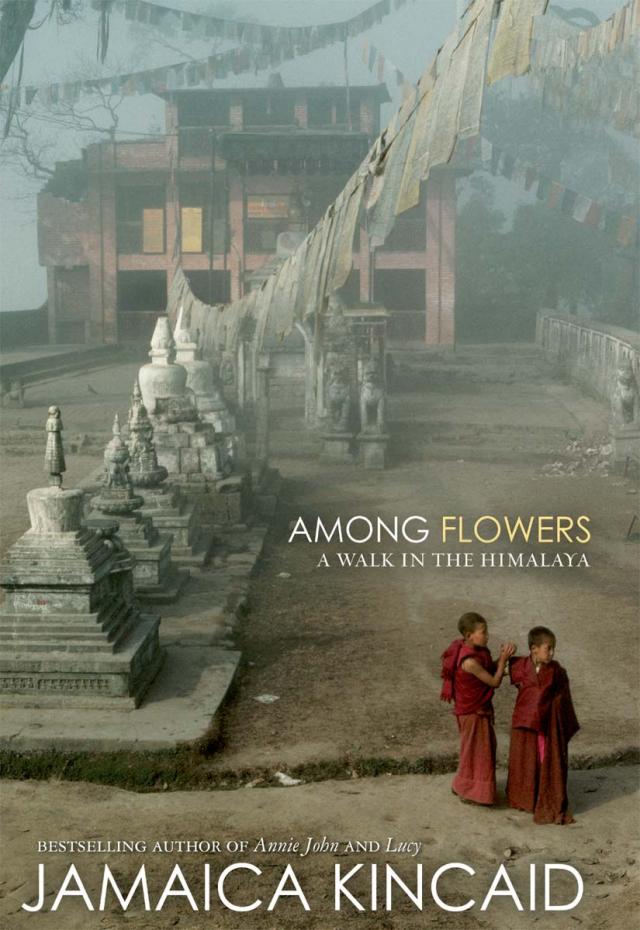
In this delightful hybrid of a book--part memoir and part travel journal--the bestselling author takes us deep into the mountains of Nepal with a trio of botanist friends in search of native Himalayan plants that will grow in her Vermont garden. Alighting from a plane in the dramatic Annapurna Valley, the ominous signs of Nepal's Maoist guerrillas are all around--an alarming presence that accompanies the travelers throughout their trek. Undaunted, the group sets off into the mountains with Sherpas and bearers, entering an exotic world of spectacular landscapes, vertiginous slopes, isolated villages, herds of yaks, and giant rhododendron, thirty feet tall. The landscape and flora and so much else of what Kincaid finds in the Himalaya--including fruit bats, colorful Buddhist prayer flags, and the hated leeches that plague much of the trip--are new to her, and she approaches it all with an acute sense of wonder and a deft eye for detail. In beautiful, introspective prose, Kincaid...
Read online
  • 65
See Now Then

See Now Then

Jamaica Kincaid

Jamaica Kincaid

In See Now Then, the brilliant and evocative new novel from Jamaica Kincaid—her first in ten years—a marriage is revealed in all its joys and agonies. This piercing examination of the manifold ways in which the passing of time operates on the human consciousness unfolds gracefully, and Kincaid inhabits each of her characters—a mother, a father, and their two children, living in a small village in New England—as they move, in their own minds, between the present, the past, and the future: for, as she writes, “the present will be now then and the past is now then and the future will be a now then.” Her characters, constrained by the world, despair in their domestic situations. But their minds wander, trying to make linear sense of what is, in fact, nonlinear. See Now Then is Kincaid’s attempt to make clear what is unclear, and to make unclear what we assumed was clear: that is, the beginning, the middle, and the end.     Since the publication of her first short-story collection, At the Bottom of the River, which was nominated for a PEN/Faulkner Award for Fiction, Kincaid has demonstrated a unique talent for seeing beyond and through the surface of things. In See Now Then, she envelops the reader in a world that is both familiar and startling—creating her most emotionally and thematically daring work yet.From BookforumIn See Now Then memories appear and reappear with a hypnotic, furious regularity, and the novel exhausts itself trying to control them—as if stanching a hemorrhage, or cauterizing a wound. —Jess Row ReviewPraise for See Now Then“Writers make uncomfortable kin . . . There’s a reflex in every writer that trumps even the maternal instinct, a part of her that, even while her newborn suckles at her breast, is cold-eyed, choosing words to describe the pit-bull clamp of its gums, the crusted globe of its skull, with the same dispassion which she might describe fellow passengers on a bus . . . The intimate treachery, the permanent duality that  this entails . . .  are lucidly examined in Jamaica Kincaid’s latest novel . . . Kincaid has the gift of endowing common experience with a mythic ferocity… [She] is one of our most scouringly vivid writers.” —Fernanda Eberstadt, New York Times Book Review“Chaucer’s Wife of Bath meets Virginia Woolf! . . . With the intensity of Virginia Woolf, Kincaid creates a palimpsest of time past, time present and time future . . . Mrs. Sweet in these pages makes a verbal symphony . . . Kincaid’s attempt to capture living itself may just be, as she puts it, ‘always just out of reach,’ but her talent for trying remains palpable on every page . . . Connoisseurs will find it delicious.” —Alan Cheuse, Chicago Tribune, Book of the MonthMost readers feel protective of that little unit, the family. When it breaks, as it so often does and most certainly will in this story, we experience the tragedy . . . Was it ever any different? Did Mr. Sweet, who so utterly resembles the absent-minded Mr. Ramsay from Virginia Woolf's To the Lighthouse, ever truly love Mrs. Sweet, a modern-day Mrs. Ramsay—the mother who struggles every day to save her family from destruction, or just unhappiness?” —Susan Salter Reynolds, Newsday“See Now Then is a hurricane of a book, a novel of psychic bewilderment and seething inaction that relentlessly defines and redefines the sense of otherness and displacement that is the permanent legacy of slavery and colonialism. An existential crisis if there ever was one, Jamaica Kincaid mines it with seriousness, tenderness and frequently savage humor in this novel, showing that it touches not just blacks, but all people, however loathe they may be to admit it. But See Now Then gives us no choice. From the first pages, its intimate, matter of fact, stream of consciousness style blurs the lines between us and them, now and then, poetry and prose, reality and imagination . . . With Kincaid, it’s never a matter of what wins, only of what is.” —Ms. Magazine“Pervasive in See Now Then . . .  is bawdy humor and unabashed  rage and sorrow  . . . The theme of time’s inexorable march and how it colors our perspective is reinforced by sometimes abruptly shifting recollections. . . Those who treasure Kincaid’s quirky lyricism will no doubt enjoy the challenge.” —*USA Today“If there is a plot to See Now Then, it is the story of Mrs. Sweet’s efforts to confront her own fear of the ‘round, turning world’ —a fear that can no longer be assuaged by incantations of age and youth. To say that Mrs. Sweet conquers her terror is too pat a summary but by the end of the novel she has reached a kind of equilibrium. It is marvelous to behold.” —Hannah Gersen, The Millions“Bold and beautiful . . . Joycean? Yes, and also much like the role of Winnie in the Samuel Beckett play ‘Happy Days’—both Winnie and Kincaid addressing us in a rush that we recognize as an actual process of thought . . . See Now Then is—by turns—lovely, even lilting, difficult, and condemning of Mr. Sweet. The good news is that everything works—Kincaid’s style, story and startling way of telling a tale of the cosmos in terms of domesticity . . . There is courage and brilliance here, and an unusual way of going about it. We hurt for Mrs. Sweet, we pull for her, we identify with her passion for her children while we somewhat understand Mr. Sweet – and fairly jump for joy when Mrs. Sweet notes that, ‘Death has no Then and Now.’” —Karen Brady, Buffalo News*“Damned, haunted and psychological . . . Kincaid’s heady fiction doesn’t unfold dramatically, but her prose does, vining and clinging to readers’ ears, blooming into a tritone musical theory—see-now-then . . . Churning through the tenses, Mrs. Sweet’s stream of consciousness is the narrative form: an aesthetic rendering of how time, memory and imagination create the fabric of being . . . In her earlier novels, misaligned family relations produce the potential for human failure. Kincaid’s female protagonist-narrators triumph against those circumstances through literary intelligence. Mrs. Sweet’s grappling with time is beautiful and brutal: It acknowledges that our failures sometimes deny surmounting and, instead, resonate across memory into persistent, heart-rending permanence.” —Walton Muyumba, Dallas Morning News
Read online
  • 50
The Autobiography of My Mother

The Autobiography of My Mother

Jamaica Kincaid

Jamaica Kincaid

Powerful, disturbing, stirring, Jamaica Kincaid's novel is the deeply charged story of a woman's life on the island of Dominica. Xuela Claudette Richardson, daughter of a Carib mother and a half-Scottish, half-African father, loses her mother to death the moment she is born and must find her way on her own. Kincaid takes us from Xuela's childhood in a home where she could hear the song of the sea to the tin-roofed room where she lives as a schoolgirl in the house of Jack Labatte, who becomes her first lover. Xuela develops a passion for the stevedore Roland, who steals bolts of Irish linen for her from the ships he unloads, but she eventually marries an English doctor, Philip Bailey. Xuela's is an intensely physical world, redolent of overripe fruit, gentian violet, sulfur, and rain on the road, and it seethes with her sorrow, her deep sympathy for those who share her history, her fear of her father, her desperate loneliness. But underlying all is "the black room of the...
Read online
  • 46
My Brother

My Brother

Jamaica Kincaid

Jamaica Kincaid

Jamaica Kincaid's brother Devon Drew died of AIDS on January 19, 1996, at the age of thirty-three. Kincaid's incantatory, poetic, and often shockingly frank recounting of her brother's life and death is also a story of her family on the island of Antigua, a constellation centered on the powerful, sometimes threatening figure of the writer's mother. My Brother is an unblinking record of a life that ended too early, and it speaks volumes about the difficult truths at the heart of all families. My Brother is a 1997 National Book Award Finalist for Nonfiction.
Read online
  • 36
Talk Stories

Talk Stories

Jamaica Kincaid

Jamaica Kincaid

From "The Talk of the Town," Jamaica Kincaid's first impressions of snobbish, mobbish New YorkTalk Pieces is a collection of Jamaica Kincaid's original writing for the New Yorker's "Talk of the Town," composed during the time when she first came to the United States from Antigua, from 1978 to 1983. Kincaid found a unique voice, at once in sync with William Shawn's tone for the quintessential elite insider's magazine, and (though unsigned) all her own--wonderingly alive to the ironies and screwball details that characterized her adopted city. New York is a town that, in return, fast adopts those who embrace it, and in these early pieces Kincaid discovers many of its hilarious secrets and urban mannerisms. She meets Miss Jamaica, visiting from Kingston, and escorts the reader to the West Indian-American Day parade in Brooklyn; she sees Ed Koch don his "Cheshire-cat smile" and watches Tammy Wynette autograph a copy of Lattimore's...
Read online
  • 35
Annie John

Annie John

Jamaica Kincaid

Jamaica Kincaid

Annie John is a haunting and provocative story of a young girl growing up on the island of Antigua. A classic coming-of-age story in the tradition of The Catcher in the Rye and A Portrait of the Artist as a Young Man, Kincaid's novel focuses on a universal, tragic, and often comic theme: the loss of childhood. Annie's voice--urgent, demanding to be heard--is one that will not soon be forgotten by readers.An adored only child, Annie has until recently lived an idyllic life. She is inseparable from her beautiful mother, a powerful presence, who is the very center of the little girl's existence. Loved and cherished, Annie grows and thrives within her mother's benign shadow. Looking back on her childhood, she reflects, "It was in such a paradise that I lived." When she turns twelve, however, Annie's life changes, in ways that are often mysterious to her. She begins to question the cultural assumptions of her island world; at school she...
Read online
  • 21
At the Bottom of the River

At the Bottom of the River

Jamaica Kincaid

Jamaica Kincaid

Jamaica Kincaid's At the Bottom of the River... inspired, lyrical short storiesReading Jamaica Kincaid is to plunge, gently, into another way of seeing both the physical world and its elusive inhabitants. Her voice is, by turns, naively whimsical and biblical in its assurance, and it speaks of what is partially remembered partly divined. The memories often concern a childhood in the Caribbean—family, manners, and landscape—as distilled and transformed by Kincaid's special style and vision.Kincaid leads her readers to consider, as if for the first time, the powerful ties between mother and child; the beauty and destructiveness of nature; the gulf between the masculine and the feminine; the significance of familiar things—a house, a cup, a pen. Transfiguring our human form and our surroundings—shedding skin, darkening an afternoon, painting a perfect place—these stories tell us something we didn't know, in a way we hadn't...
Read online
  • 18
Mr. Potter

Mr. Potter

Jamaica Kincaid

Jamaica Kincaid

The story of an ordinary man, his century, and his home: "Kincaid's most poetic and affecting novel to date" (Robert Antoni, The Washington Post Book World)Jamaica Kincaid's first obssession, the island of Antigua, comes vibrantly to life under the gaze of Mr. Potter, an illiterate taxi chauffeur who makes his living along the roads that pass through the only towns he has ever seen and the graveyard where he will be buried. The sun shines squarely overhead, the ocean lies on every side, and suppressed passion fills the air.Ignoring the legacy of his father, a poor fisherman, and his mother, who committed suicide, Mr. Potter struggles to live at ease amid his surroundings: to purchase a car, to have girlfriends, and to shake off the encumbrance of his daughters—one of whom will return to Antigua after he dies and tell his story with equal measures of distance and sympathy. In Mr. Potter, Kincaid breathes...
Read online
  • 17
A Small Place

A Small Place

Jamaica Kincaid

Jamaica Kincaid

A brilliant look at colonialism and its effects in Antigua—by the author of Annie John"If you go to Antigua as a tourist, this is what you will see. If you come by aeroplane, you will land at the V. C. Bird International Airport. Vere Cornwall (V. C.) Bird is the Prime Minister of Antigua. You may be the sort of tourist who would wonder why a Prime Minister would want an airport named after him—why not a school, why not a hospital, why not some great public monument. You are a tourist and you have not yet seen . . ."So begins Jamaica Kincaid's expansive essay, which shows us what we have not yet seen of the ten-by-twelve-mile island in the British West Indies where she grew up.Lyrical, sardonic, and forthright by turns, in a Swiftian mode, A Small Place cannot help but amplify our vision of one small place and all that it signifies.
Read online
  • 12
My Garden (Book)

My Garden (Book)

Jamaica Kincaid

Jamaica Kincaid

One of our finest writers on one of her greatest loves. Jamaica Kincaid's first garden in Vermont was a plot in the middle of her front lawn. There, to the consternation of more experienced friends, she planted only seeds of the flowers she liked best. In My Garden (Book): she gathers all she loves about gardening and plants, and examines it generously, passionately, and with sharp, idiosyncratic discrimination. Kincaid's affections are matched in intensity only by her dislikes. She loves spring and summer but cannot bring herself to love winter, for it hides the garden. She adores the rhododron Jane Grant, and appreciates ordinary Blue Lake string beans, but abhors the Asiatic lily. The sources of her inspiration -- seed catalogues, the gardener Gertrude Jekyll, gardens like Monet's at Giverny -- are subjected to intense scrutiny. She also examines the idea of the garden on Antigua, where she grew up. My Garden (Book): is an intimate, playful, and penetrating book on...
Read online
  • 12
183